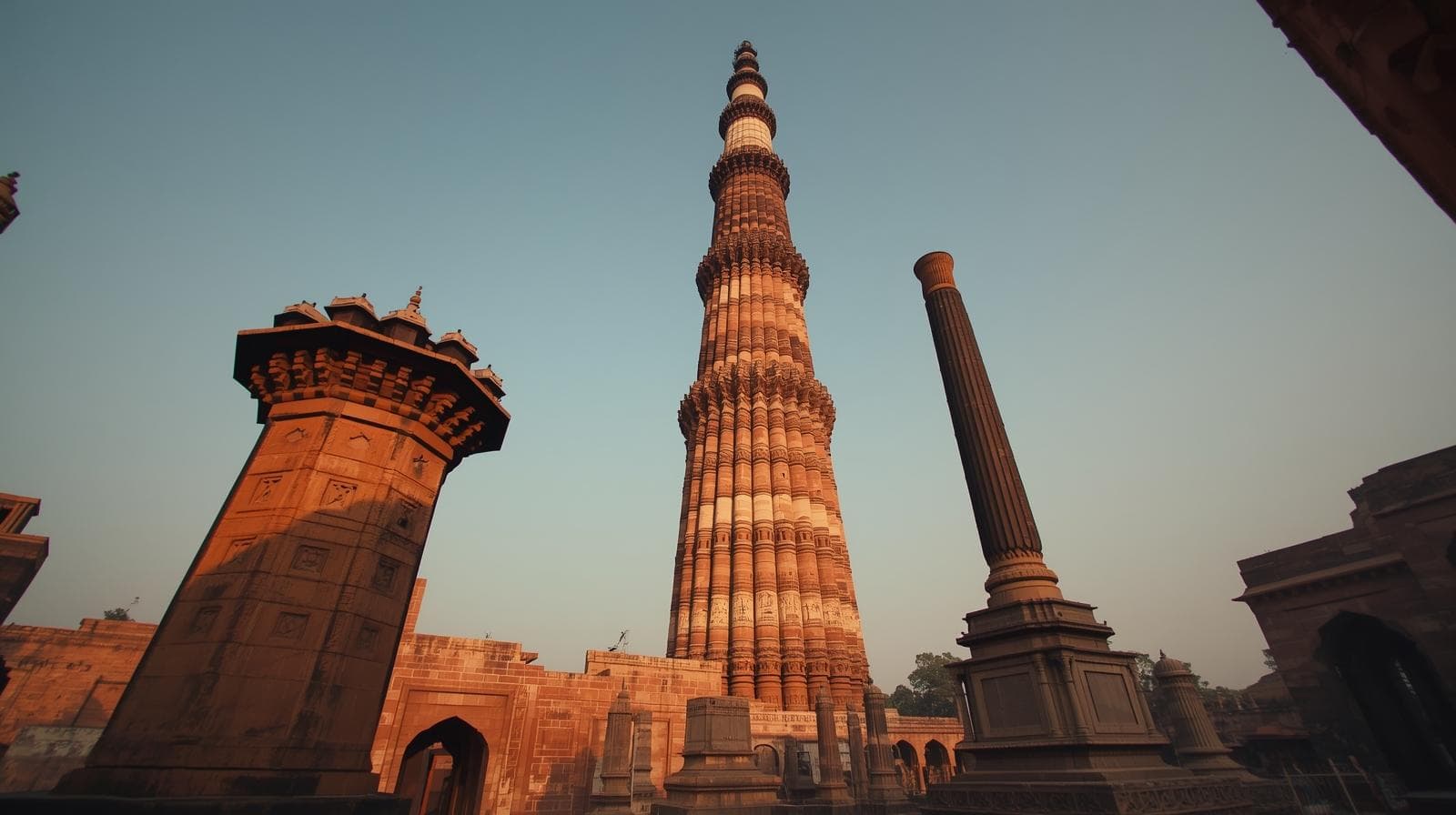
Soaring 73 meters into the sky, the Qutub Minar is the tallest brick minaret in the world and a masterpiece of Indo-Islamic architecture. Built to celebrate Muslim dominance in Delhi after the defeat of Delhi's last Hindu ruler, it marks the beginning of Muslim rule in India. Today, it stands as a UNESCO World Heritage Site in the leafy Mehrauli neighborhood.
But the Qutub Complex is more than just the tower. It houses ruins that are centuries older, including a mosque built from the debris of 27 Hindu and Jain temples and a mysterious iron pillar that refuses to rust even after 1,600 years.
The Qutub Minar: Tower of Victory
Construction started in 1192 by Qutb-ud-din Aibak, but he only finished the basement. His successor Iltutmish added three more stories, and later Firoz Shah Tughlaq added the final two stories of marble and sandstone. This explains the slight change in architectural style as you look up.
- Height: 72.5 meters (238 feet).
- Steps: 379 spiral steps (closed to public since 1981 due to an accident).
- Design: The first three storeys are made of red sandstone; the fourth and fifth are of marble and sandstone.
Other Must-See Structures in the Complex
1. The Iron Pillar of Delhi
This is a metallurgical wonder. Standing in the courtyard of the mosque, this 7-meter high iron pillar dates back to the Gupta Empire (around 402 AD). Despite being exposed to the elements for over 1,600 years, it has not rusted. Scientists attribute this to a protective layer of "misawite" formed due to high phosphorus content in the ancient iron.
2. Quwwat-ul-Islam Mosque
The first mosque built in Delhi. If you look closely at the pillars, you will see clearly Hindu motifs like bells, garlands, and lotuses. Historical records state it was built using materials from 27 destroyed temples.
3. Alai Minar
You'll see a massive, unfinished base of a tower north of Qutub Minar. This is the Alai Minar. Alauddin Khilji wanted to build a tower twice as high as Qutub Minar to show his power. However, he died after the first storey was built, and no one touched it since.
4. Alai Darwaza
The southern gateway to the mosque, built by Alauddin Khilji in 1311. It is the first building in India to employ true Islamic architectural principles (true arches and true domes).
Visitor Information
- Timings: Sunrise to Sunset (approx 7 AM to 9 PM). The complex is beautifully lit up at night.
- Entry Fee: ₹40 (Indians), ₹600 (Foreigners). Scanning QR code at entry is faster than counter queue.
- Best Time: Late afternoon. Explore the complex and stay for sunset to see the silhouette of the minar against an orange sky. Evening illumination starts around 7:30 PM.
📸 Delhi Photography Tour
Qutub Minar provides some of the best photo ops in Delhi. Book a private car for a flexible photography tour of Delhi's monuments.
Check Car Rental Rates