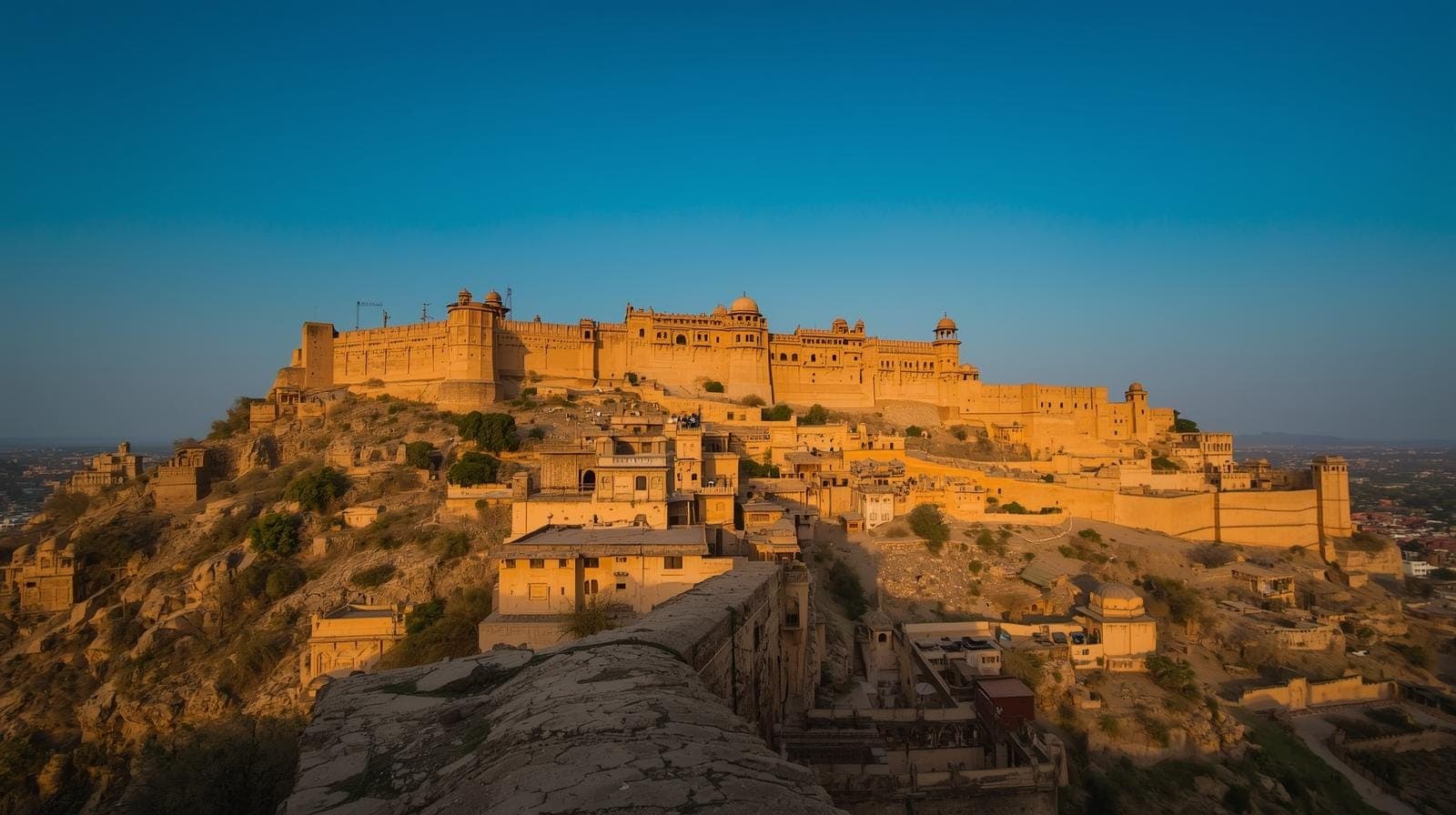

Chittorgarh is the largest fort in India by area, spread over roughly 280 hectares on a hill above the town, and it is a UNESCO World Heritage site. The single most useful thing to know before going: the fort is too large to walk. A road runs through it and visitors drive or hire an auto between the monuments, which are spread over several kilometres. It sits about 115 km from Udaipur and 310 km from Jaipur, and three to four hours covers it properly.
The scale, and why it changes how you visit
Most Rajasthani forts are a single dense complex you walk around in ninety minutes. Chittorgarh is not. It is a fortified plateau roughly five kilometres long with monuments scattered across it, connected by a road and seven successive gateways on the climb up.
Visitors who arrive expecting Amber or Mehrangarh and set off on foot see perhaps a third of it and leave disappointed. The practical arrangement is to keep your vehicle, or hire an auto at the top, and move between the Vijay Stambh, the palaces, the temples and the Padmini complex.
Allow three to four hours. A guide is more useful here than at most forts because the monuments are separated and the history that connects them is not self-evident from the stones.
Vijay Stambh, the tower of victory
The Vijay Stambh is the image of Chittorgarh: a nine-storey tower of about 37 metres raised by Rana Kumbha in the 1440s to mark a victory over the Sultan of Malwa. The same ruler built Kumbhalgarh.
It is covered inside and out in carved figures — the Hindu pantheon in tiers, with inscriptions recording the dynasty. A narrow internal staircase climbs to the top and the view across the plateau is the best orientation you will get of how large the fort actually is. The stair is tight and unlit in places; it is not for everyone.
The older Kirti Stambh, the tower of fame, stands elsewhere on the plateau — twelfth-century, Jain, smaller at 22 metres, and far quieter.
| Stop | What it is | Time |
|---|---|---|
| Vijay Stambh | 15th-century victory tower, climbable | 45 min |
| Rana Kumbha Palace | Oldest structure; the jauhar site | 30 min |
| Padmini Palace | Water palace and the mirror legend | 30 min |
| Kirti Stambh | 12th-century Jain tower, quiet | 20 min |
| Meera and Kumbha Shyam temples | Meerabai association | 30 min |
The three sieges, stated carefully
Chittorgarh's significance in Rajasthani memory rests on three sieges — by Alauddin Khilji in 1303, Bahadur Shah of Gujarat in 1535, and Akbar in 1568 — and on what the chronicles record happening when the fort could no longer hold: jauhar, the mass self-immolation of the women, followed by saka, the men riding out in saffron to die fighting.
The Rana Kumbha Palace contains the underground chambers traditionally identified with the jauhar. It is a quiet, unadorned place and visitors generally fall silent in it.
A note on the history: the 1303 siege and the story of Rani Padmini come to us largely through Malik Muhammad Jayasi's Padmavat, written more than two centuries later, and historians differ sharply on how much is record and how much is poetry. That debate does not diminish the place — it is part of why a guide here is worth taking, because the fort is where legend and chronicle sit on top of each other.
Padmini Palace
The Padmini Palace is a white water palace set in a pool, and the story attached to it is the one everybody arrives knowing: that Alauddin Khilji was permitted to see Rani Padmini only as a reflection in a mirror, and that the glimpse set off the siege.
The building itself is modest and much restored. It is visited for the association rather than the architecture, and the setting across the water is genuinely pretty in the late afternoon.
When to come, and getting there
October to March is the season. The plateau is open and exposed with very little shade, and summer afternoons here are severe — if you must come in May or June, be at the gate when it opens and be finished by eleven.
Chittorgarh sits almost exactly between Udaipur (115 km, two and a half hours) and Jaipur, which makes it a natural stop on that leg rather than a separate journey. Many travellers take it on the way between the two and never need a night in the town.
There is a sound-and-light show in the evening at the Rana Kumbha Palace for anyone staying over.
Questions people ask
Can I walk around Chittorgarh Fort?
Not practically. It covers about 280 hectares with monuments kilometres apart. Keep your vehicle or hire an auto at the top — walkers see roughly a third of it.
How long does Chittorgarh need?
Three to four hours for the main monuments. It works best as a stop between Udaipur and Jaipur rather than a destination with its own night.
Is the Padmini story historical?
It reaches us mainly through Jayasi's Padmavat, written over two centuries after the 1303 siege, and historians differ on how much is record. The fort is worth visiting either way.
Can I climb the Vijay Stambh?
Yes, by a narrow internal staircase to the top, and the view is the best orientation of the fort you will get. It is tight and unlit in parts.