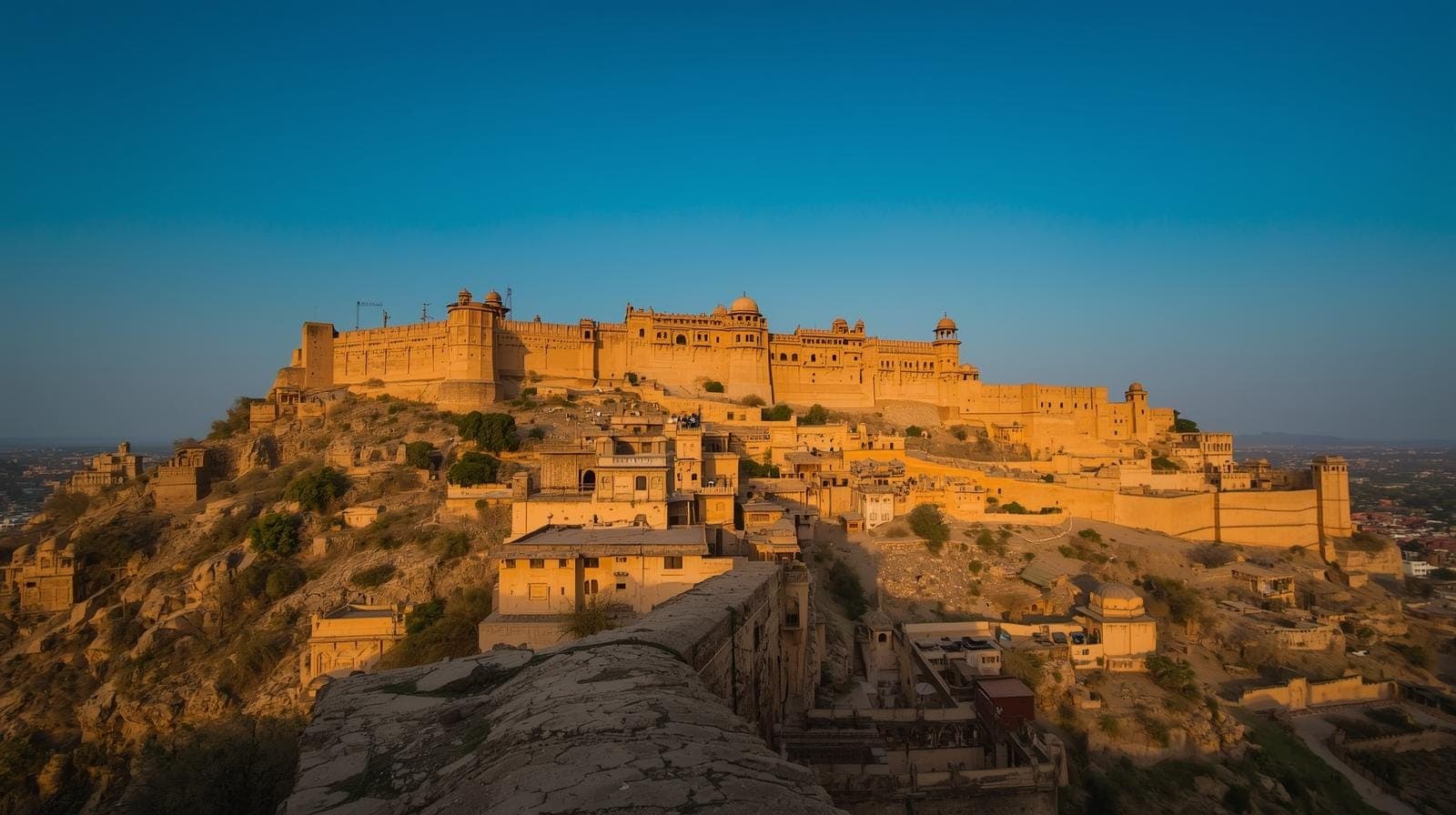

Kumbhalgarh's perimeter wall runs about 36 km through the Aravalli hills, making it the second-longest continuous wall in the world after the Great Wall of China. The fort was built in the fifteenth century by Rana Kumbha, was never taken by direct assault, and is the birthplace of Maharana Pratap. It is a UNESCO World Heritage site, about 85 km from Udaipur and two hours by road, and it works best as a day trip from there or paired with Ranakpur.
The wall, which is the point
The rampart runs for roughly 36 km over the ridges around the fort, broad enough along much of its length that the standard local claim — eight horses could ride abreast on it — is plausible. It is punctuated by seven fortified gateways and over three hundred temples within the enclosure.
Visitors can walk sections of it. There is no complete circuit on offer and no need for one: an hour along the wall from the fort gives the whole sense of the thing, with the Aravallis falling away on both sides and the rampart snaking over hills into the distance.
The scale is difficult to photograph and easy to underestimate from descriptions. It is the single most impressive piece of military architecture in Rajasthan, and it receives a small fraction of the visitors that Amber does.
Why it was never taken
Rana Kumbha built Kumbhalgarh in the 1440s as the second most important stronghold of Mewar after Chittorgarh, and it served as the refuge when Chittorgarh fell. Its position — on a ridge at about 1,100 m, approached through steep broken country — made a conventional siege extremely difficult.
It was breached once, and not by assault. A combined force of the Mughals, Amber and Marwar laid siege and the fort fell only when its water supply was poisoned. That single episode is the exception that frames the rest of its record.
The Badal Mahal at the summit, the palace of clouds, is the highest point and the best view — pastel-painted rooms and a terrace looking out over the whole wall system and, on a clear day, as far as the dunes at the edge of the Thar.
| Detail | |
|---|---|
| From Udaipur | about 85 km, two hours |
| From Jodhpur | about 200 km, four hours |
| Time needed | Three to four hours for fort and wall |
| Pairs with | Ranakpur Jain temple, about 50 km |
| Best season | October to March |
Maharana Pratap
Kumbhalgarh is where Maharana Pratap was born in 1540, which gives the fort a particular significance in Rajasthani memory beyond its architecture. Pratap is the ruler who refused accommodation with Akbar, fought the Battle of Haldighati in 1576 and spent years in the hills rather than submit — and Kumbhalgarh was the base from which much of that resistance was mounted.
There is a cenotaph and a museum presence at the fort. For visitors unfamiliar with the history, a guide at the entrance is genuinely worth taking: the fort reads very differently once the Mewar–Mughal story is attached to it.
The light show, and timing
An evening sound-and-light show runs at the fort, in Hindi, covering the history of Mewar and the fort's sieges. It is well regarded and adds an hour. Timings vary by season and it does not run every day — check before planning an evening around it.
Arriving in the early morning is the better choice for the fort itself. The climb to Badal Mahal is exposed, the Aravalli sun is strong by eleven, and the morning light along the wall is far better for photography.
Ranakpur, which should be the same trip
About 50 km from Kumbhalgarh is the Ranakpur Jain temple, a fifteenth-century marble structure with 1,444 carved pillars, no two alike. It is one of the most extraordinary buildings in India and the two sites are almost always combined into a single day from Udaipur.
Ranakpur has restricted visiting hours for non-Jain visitors, usually from around noon, with the mornings reserved for worship. That constraint sets the shape of the day: Kumbhalgarh first thing, Ranakpur after midday, back to Udaipur in the evening.
Getting there
From Udaipur it is about 85 km and two hours on hill roads. From Jodhpur it is around 200 km and four hours, which makes it a reasonable stop when moving between the two.
October to March is the season; the wall walk and the climb to Badal Mahal are both exposed and the summer heat makes them unwise. Monsoon turns the Aravallis green and is unexpectedly good here, with the wall appearing and disappearing in cloud.
Questions people ask
Is Kumbhalgarh really the second-longest wall in the world?
Its perimeter runs about 36 km, which is generally cited as second only to the Great Wall of China among continuous fortification walls.
Can I walk the whole wall?
No, and there is no need. An hour along a section from the fort conveys the scale; there is no maintained full circuit.
How long do I need at Kumbhalgarh?
Three to four hours for the fort, Badal Mahal and a stretch of wall. A full day if combining with Ranakpur.
Should I combine it with Ranakpur?
Yes — they are 50 km apart and almost always done together from Udaipur. Note Ranakpur opens to non-Jain visitors only from around midday, so do Kumbhalgarh first.