Jaisalmer is about 285 km from Jodhpur and five hours by road, and its fort is one of very few living forts in the world — roughly a quarter of the city's population still lives inside the walls. Two nights is the right length: one for the fort, the havelis and Gadisar Lake, one for a desert camp at Sam or Khuri. The season is October to March; May and June regularly pass 45°C. Staying inside the fort is possible and is a decision with consequences worth understanding first.
A fort people still live in
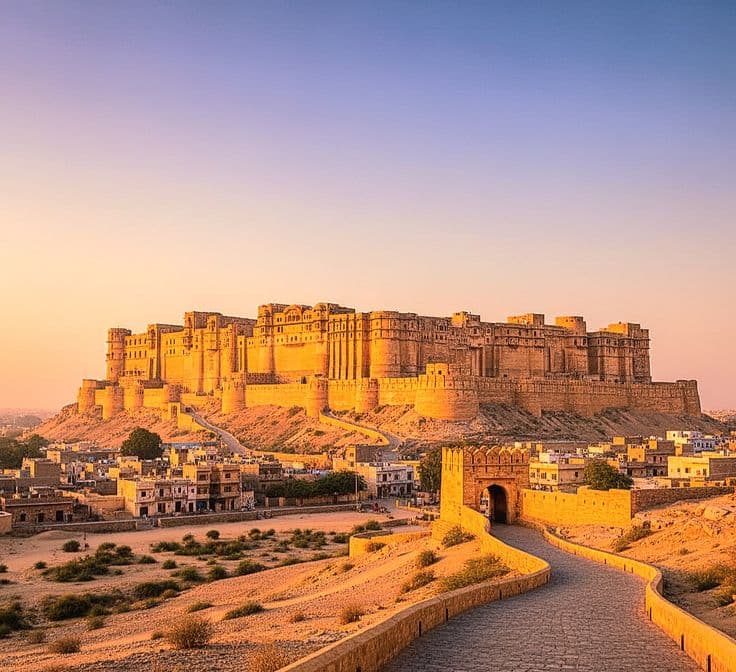
Most Rajasthani forts are monuments with a ticket office. Jaisalmer Fort — Sonar Quila, the golden fort — is a functioning neighbourhood: homes, shops, guesthouses, temples and restaurants inside twelfth-century walls on a hill above the town, built of the same yellow sandstone as everything else, which is why the whole city turns gold in the late afternoon.
Walking into it is not like entering a monument. It is narrow lanes, motorbikes, cows, washing lines and families, with Jain temples of extraordinary carving a few doors from a shop selling bedcovers.
The Jain temples inside, a cluster of seven built between the twelfth and sixteenth centuries, are the finest thing in the fort and are frequently skipped by visitors who only walk the ramparts. They have restricted hours for non-Jain visitors — usually mornings — so they need to be planned around.
The problem with staying inside, stated plainly
Sleeping inside a living twelfth-century fort is an appealing idea and many guesthouses sell it.
It also has a well-documented cost. The fort was built for a small population with minimal water. Modern plumbing, piped supply and the drainage demands of guesthouses have saturated the foundations, and conservation bodies have repeatedly warned that water seepage is causing structural damage — bastions have collapsed. The fort has appeared on heritage watch lists for precisely this reason.
There is a genuine argument on the other side: the people living there are not tourists and have the same right to plumbing as anyone. But a visitor choosing where to sleep has a choice, and the lower-impact one is a haveli hotel in the town below, with the fort ten minutes' walk away.
This is said here because almost nothing selling Jaisalmer mentions it.
| Morning | Afternoon / evening | |
|---|---|---|
| Day one | Fort lanes and the Jain temples | Patwon Ki Haveli; Gadisar Lake at sunset |
| Day two | Salim Singh and Nathmal havelis | Drive to Sam or Khuri; dunes at sunset; camp night |
| Day three | Return; Kuldhara ruins en route | Onward to Jodhpur or Bikaner |
The havelis
Patwon Ki Haveli is the largest and most elaborate — actually five havelis built by a single trading family in the early nineteenth century, with carved stone facades and balconies that are the most photographed thing in the town after the fort. Part is a museum.
Salim Singh Ki Haveli has a distinctive peacock-shaped upper storey and a grim story attached to the prime minister who built it. Nathmal Ki Haveli was carved by two brothers working on opposite sides, and the two halves are near-symmetrical but not identical — which is the detail worth looking for.
Choosing a desert camp
The desert night is the other half of Jaisalmer, and the quality varies enormously.
Sam, about 40 km west, has the big dunes and the most camps. In peak season it is busy — camel trains, jeeps, generators and amplified music — and travellers expecting silence under stars are regularly disappointed. Khuri, about 50 km south-west, is quieter and smaller, with lower dunes and a more village feel.
Three questions separate a good camp from a car park. How far are the tents from the dune road — a camp set back has a different night from one beside the access track. Is there amplified entertainment, and until when. And is the camel or jeep ride a fixed short circuit or a proper ride out.
Ask these before booking rather than on arrival. The price difference between the two kinds of camp is often small; the difference in the night is not.
Kuldhara
About 18 km from Jaisalmer is Kuldhara, an abandoned village of some 85 settlements whose Paliwal Brahmin inhabitants are said to have left overnight in the nineteenth century, cursing the site. The ruins are extensive, the setting is bleak and striking, and it takes half an hour on the way to Sam.
The curse story is good and the abandonment is historically real, though the causes are more likely to have been water scarcity and taxation than a minister's unwanted attentions.
When and how
October to March, firmly. Desert days in November and December are perfect and the nights genuinely cold — a camp in January needs more clothing than people pack. The Desert Festival in February is a significant draw and fills the town.
April to June is severe; a fort visit at 45°C is not sightseeing. Monsoon is brief and light here.
From Jodhpur it is 285 km and about five hours, and that is the usual approach on a Rajasthan circuit. Triveni Cabs covers the route; Bikaner at 330 km is the other natural link, making a Jodhpur–Jaisalmer–Bikaner desert loop.
Questions people ask
Should I stay inside Jaisalmer Fort?
It is possible and atmospheric, but the fort has serious water-seepage damage attributed partly to guesthouse drainage, and bastions have collapsed. A haveli hotel in the town below is ten minutes away and lower impact.
Sam or Khuri for the desert camp?
Sam has the bigger dunes and far more camps, and is busy and noisy in season. Khuri is quieter and smaller. Ask about distance from the dune road and amplified music before booking either.
How many days does Jaisalmer need?
Two nights: one in town for the fort and havelis, one at a desert camp. A third allows Kuldhara and an unhurried morning.
When can I visit the Jain temples in the fort?
They have restricted hours for non-Jain visitors, usually mornings. Plan the fort visit around them rather than hoping.