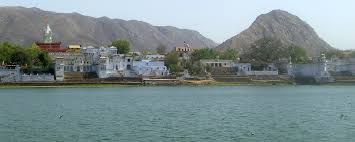
Pushkar holds one of the very few temples in India dedicated to Brahma, and its lake is ringed by 52 ghats that are a working place of worship rather than a viewpoint. Shoes come off at the ghats, photography of people bathing is not acceptable, and the "puja" offered by men who approach visitors on the steps is a well-known donation arrangement rather than a temple rite. Ajmer, with the Dargah Sharif, is 15 km away and pairs naturally. The Pushkar Camel Fair falls around Kartik Purnima, usually in November.
The Brahma temple, and why it is unusual
Brahma is one of the principal Hindu deities and almost nowhere receives temple worship. Pushkar's temple, on the western edge of the lake, is the best-known exception in India — which is why pilgrims travel here specifically and why the town's religious significance is out of proportion to its size.
The temple itself is modest: red spire, silver turtle set into the floor, a marble courtyard. It is the rarity rather than the grandeur that matters. Phones and cameras are generally not permitted inside and there are lockers at the entrance. Mornings are calmer; the evening aarti is busier and more atmospheric.
The ghats, and the arrangement on the steps
The lake is surrounded by 52 ghats, each associated with a different ruler or community, and bathing in it is the religious act that brings most pilgrims. Visitors are welcome, with the same courtesies any working religious site deserves: shoes off before the steps, no photographs of people bathing, modest dress, no alcohol or leather carried onto the ghats.
The "Pushkar passport" is worth knowing about before you arrive. Men will approach on the steps, offer to perform a puja, place flowers in your hand and begin a blessing — and will then name a donation figure, often a large one, tying it to the number of family members mentioned during the ritual. A red thread is then tied on the wrist, which is where the nickname comes from.
This is not a scam in the sense of being illegal, and some of these men are connected to the ghats. It is simply a transaction being framed as a rite. If you want a puja, agree the offering beforehand. If you do not, decline politely before flowers are placed in your hand, because declining afterwards is much harder.
| Morning | Afternoon | |
|---|---|---|
| Day one | Brahma temple and a slow walk round the ghats | The bazaar; Savitri temple by ropeway for sunset |
| Day two | Ajmer — Dargah Sharif, Adhai Din ka Jhonpra | Ana Sagar lake, then onward to Jaipur or Jodhpur |
Ajmer
Ajmer is 15 km from Pushkar over the Nag Pahar hills and is a substantially larger and busier city. The Dargah Sharif, the shrine of the Sufi saint Moinuddin Chishti, is among the most important Islamic pilgrimage sites in South Asia and draws visitors of every faith. The approach is through a dense bazaar; heads are covered, shoes left, and the courtyards are crowded and intense in a way Pushkar is not.
Adhai Din ka Jhonpra, a short walk away, is a twelfth-century mosque built from the remains of earlier temples, with a carved screen that is one of the finest pieces of early Indo-Islamic architecture in the country. It is far quieter than the dargah and frequently skipped.
The Camel Fair
The Pushkar Camel Fair takes place around Kartik Purnima, which usually falls in November, with the livestock trading starting several days before the religious days and the crowds peaking at the full moon. It is a genuine working livestock market with a fairground attached, not a performance arranged for visitors — though the competitions and the tourist camps around it certainly are.
Accommodation prices multiply during the fair and the town is extremely full. Book months ahead or stay in Ajmer and travel in. The dates shift each year with the lunar calendar, so confirm them against the current year's calendar rather than assuming a fixed week.
Practical notes
Pushkar is a vegetarian town and alcohol is not sold — this is observed, not nominal. The main bazaar is good for silver, embroidered textiles and leather, with prices that reward unhurried negotiation.
The town is small and entirely walkable; the lake circuit takes under an hour. Ajmer needs a vehicle. Pushkar is about 150 km from Jaipur, roughly three hours, and sits conveniently between Jaipur and Udaipur or Jodhpur on a Rajasthan circuit.
Questions people ask
Why is a Brahma temple unusual?
Brahma receives temple worship almost nowhere in India despite being a principal deity. Pushkar’s is the best-known exception, which is the source of the town’s pilgrimage importance.
What is the "Pushkar passport"?
A donation arrangement on the ghats: a puja is begun, flowers are placed in your hand, a figure is named and a red thread tied on the wrist. Agree any offering beforehand, or decline before the flowers are handed over.
When is the Camel Fair?
Around Kartik Purnima, usually in November, with dates moving each year on the lunar calendar. Accommodation should be booked months ahead.
Can I drink alcohol in Pushkar?
No. It is a vegetarian town and alcohol is not sold, and this is genuinely observed rather than nominal.