Lansdowne is a cantonment town at about 1,700 m in Pauri Garhwal, roughly 250 km from Delhi and six hours by road. It is run by the army — the Garhwal Rifles regimental centre is here — which is why it has no high-rises, no commercial sprawl and, genuinely, very little to do. That is the entire point of it. There are three or four small sights, a great deal of pine forest and oak, and no nightlife whatsoever. Visitors who want quiet find it one of the best weekends from Delhi; those who want activity should go elsewhere.
Why it stayed small
Lansdowne was established in 1887 as the regimental centre of the Garhwal Rifles and remains an active cantonment. The Cantonment Board governs construction, so the hotel and shop development that reshaped Mussoorie and Nainital never happened here.
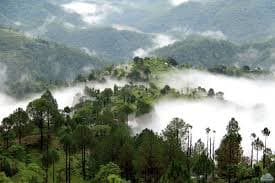
What survives is a small town of colonial buildings, church spires, a parade ground and tree-lined roads, with the Garhwal Rifles War Memorial at its centre. Parts of the town are army land with access restrictions, which is normal and signposted.
The result is the quietest accessible hill station in Uttarakhand, and the one people recommend to each other rather than find in advertising.
| Place | What it is | Time |
|---|---|---|
| Tip-n-Top | The viewpoint; Himalaya on a clear day | 30 min |
| Bhulla Lake | Small man-made lake, boating, army-maintained | 45 min |
| St Mary's Church | 1896, now a small museum | 20 min |
| Darwan Singh Museum | Garhwal Rifles regimental history | 45 min |
| Tarkeshwar Mahadev | Shiva temple in deodar, 38 km | half day |
Tip-n-Top, and the view that depends on the day
Tip-n-Top — also signposted Tiffin Top — is a short walk or drive from the town and is the reason most people come. On a clear morning the view runs along the Shivalik ranges to the snow line, with the Garhwal Himalaya visible to the north.
On a hazy afternoon it is a pleasant wooded viewpoint with nothing in the distance. The difference is entirely the weather and the hour, and early morning in October or November is when it delivers.
Bhulla Lake and the museum
Bhulla Lake is small, man-made and maintained by the army — "bhulla" is Garhwali for younger brother, in honour of the regiment's soldiers. There is boating, a small garden and a cafe, and it is well kept in a way that public spaces in hill towns often are not. It is a pleasant hour and not a destination.
The Darwan Singh Sangrahalaya, the Garhwal Rifles museum, is the most substantial thing in Lansdowne. It holds the regiment's history from 1887 through both world wars and after, with uniforms, weapons and the record of its Victoria Crosses. For anyone with an interest in military history it is worth the trip on its own, and it is far better than a small-town regimental museum has any right to be.
Tarkeshwar Mahadev
About 38 km from town, Tarkeshwar Mahadev is a Shiva temple set in an old deodar forest at around 2,100 m. The drive takes roughly an hour and a half each way on a narrow road, and the forest around the temple is the real attraction — very tall, very old trees and near-complete silence.
It makes a half-day and it is the one trip out of Lansdowne that is unambiguously worth the time.
An honest account of the weekend
A weekend in Lansdowne is: arrive Friday evening, walk the town on Saturday morning, Bhulla Lake and the museum in the afternoon, Tip-n-Top at dawn on Sunday, drive back. Or: arrive, read, walk in the forest, eat at the hotel, repeat.
There are no restaurants to speak of beyond hotel dining rooms and a handful of cafes. There is no market worth the name. Phone signal is patchy in parts. Evening entertainment is the hotel.
For a certain kind of traveller — one who wants a book, a pine forest and no decisions — this is close to ideal, and the absence of things to do is exactly what they are paying for. For a family with teenagers it will be a long two days. Both reactions are correct and the difference is expectation.
Getting there
From Delhi it is about 250 km and five to six hours via Meerut and Kotdwar, with the last 40 km a steady climb from Kotdwar. From Haridwar it is around 150 km and from Rishikesh about 160.
March to June and September to November are the good windows, with October and November giving the clearest Himalayan views. Monsoon brings landslide risk on the Kotdwar climb. Winter is cold and very quiet with occasional light snow.
Accommodation is limited — a few hotels and army guest houses — and weekends book out. This is not a town to arrive in without a reservation.
Questions people ask
Is there anything to do in Lansdowne?
Honestly, very little: a viewpoint, a small lake, a good regimental museum and a temple in a deodar forest 38 km away. That is the appeal for most people who love it, and the complaint from everyone who does not.
How far is Lansdowne from Delhi?
About 250 km, five to six hours via Meerut and Kotdwar. The final 40 km from Kotdwar is the mountain section.
Why is Lansdowne so undeveloped?
It is an active army cantonment and the Cantonment Board controls construction, so the commercial development that reshaped Mussoorie and Nainital never happened.
When are the Himalayan views best?
Early morning in October and November. In summer haze and monsoon cloud, Tip-n-Top often shows nothing in the distance.