Pahalgam is about 90 km from Srinagar, roughly two and a half hours by road, and sits at 2,130 m on the Lidder river. The three valleys beyond the town — Betaab, Aru and Chandanwari — cannot be reached in your own vehicle: visitors transfer to a local union taxi at Pahalgam for that leg. Betaab is the closest and most photographed, Aru is the prettiest and the walking base, and Chandanwari is the Amarnath yatra trailhead and the one with snow longest into the year.
The vehicle change, and why it surprises people
This is the single most common surprise in a Pahalgam day. Whatever car brings you from Srinagar stops at Pahalgam. The road onward into Betaab, Aru and Chandanwari is served by a local taxi union, and outside vehicles are not permitted on it. You hire a union vehicle at the stand, usually on a fixed-rate basis covering one, two or all three valleys.
There is nothing irregular about this — it is a long-standing local arrangement — but it is a separate cost that package quotes frequently omit. Ask before the day whether the valley taxi is included in what you have booked. If it is not, budget for it and agree which valleys the rate covers before setting off, because a one-valley rate and a three-valley rate are different numbers.
| Valley | Distance from Pahalgam | What it is |
|---|---|---|
| Betaab | about 15 km | The famous one — meadow, river, mountain backdrop, busiest |
| Aru | about 12 km | Quieter meadow village, the base for walks and the Kolahoi trek |
| Chandanwari | about 16 km | Amarnath yatra trailhead, snow bridge, highest and coldest |
Betaab Valley
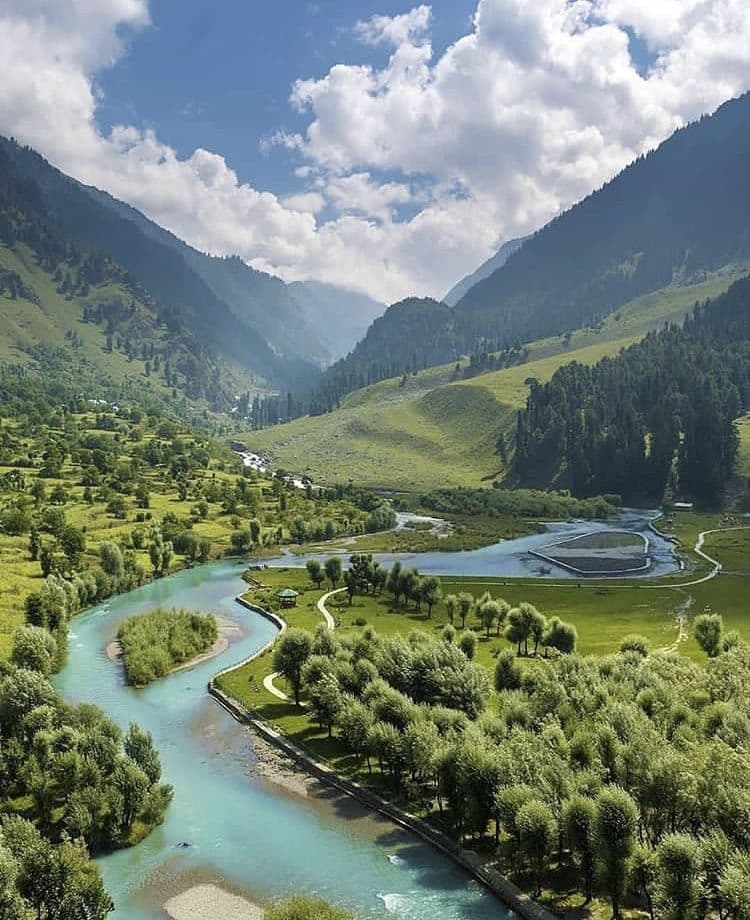
Named after the 1983 film shot there, Betaab is a broad meadow enclosed by steep pine-covered slopes with the Lidder running through it. It is the postcard of Pahalgam and consequently the most crowded. There is an entry fee, a laid-out path, pony stands and food stalls.
It deserves its reputation — the enclosure of the valley is genuinely striking — but it is a managed attraction rather than a wild place. An hour and a half covers it comfortably. Early morning, before the Srinagar day-trippers arrive around eleven, is a different and much better experience.
Aru Valley
Aru is the one that rewards travellers who want to walk. It is a small village at the head of a wide meadow, with the Lidder shallower and faster here, and it is the starting point for the Kolahoi glacier trek and several shorter walks. There are a handful of guesthouses, which makes Aru the only one of the three where staying overnight is sensible.
If you have time for only one valley and you prefer space over spectacle, make it Aru. If you are travelling with people who want the recognisable view, make it Betaab.
Chandanwari
Chandanwari is 16 km up the Lidder from Pahalgam at about 2,900 m and is the official starting point of the Amarnath yatra. Its particular draw is the snow bridge — a mass of packed avalanche snow across the river that survives well into summer, so that visitors arriving in June can still stand on snow.
During the yatra season, roughly July and August, the road and the whole area are given over to the pilgrimage and are extremely busy. Outside that window it is quiet, and it is the coldest of the three valleys at any time of year.
Ponies, and how to handle the rates
Pony rides are offered at every valley and at the Pahalgam stand itself, and the negotiation is a normal part of the day. Rates are nominally fixed by the pony-wallah union and posted at the stands; in practice the asking price moves with the season and the crowd.
Three things keep it straightforward. Agree the exact destination, not just a duration — "to the viewpoint and back" is clear, "an hour" is not. Agree the price per pony before mounting, and be clear whether it is one way or return. And decide in advance whether you actually want to ride: the valley floors at Betaab and Aru are easy walking, and the pony is a convenience rather than a necessity.
When to go
April to June is the strongest window — meadows green, the Lidder high with snowmelt, and snow still lying at Chandanwari. July and August bring the Amarnath yatra and the heaviest crowds, along with the valley's warmest weather. September and October are quiet, clear and cool, with autumn colour along the river.
November to March is cold and the upper valleys may be cut off by snow. Pahalgam town itself stays accessible, and it is a peaceful place in winter, but the three-valley circuit that most visitors come for may not be available.
Doing it from Srinagar
Two and a half hours each way means an early start and a long day. Leaving Srinagar by 7 am gets you to Betaab before the crowd; leaving at 10 means arriving into the busiest part of the day with the light already flat.
A chauffeur-driven car from Srinagar is the usual arrangement, with the driver waiting at Pahalgam while you take the union taxi into the valleys. Triveni Cabs runs this as a standard day trip from Srinagar; the fare covers fuel, the driver and GST, while the valley taxi, pony rides and valley entry fees are paid locally at actual.
Questions people ask
Why can’t my own car go into Betaab Valley?
The road beyond Pahalgam into the three valleys is served by a local taxi union and outside vehicles are not allowed on it. You hire a union vehicle at the Pahalgam stand for that leg.
Is the valley taxi included in a Srinagar day-trip package?
Often not. Ask explicitly before the day, and confirm whether the quoted rate covers one valley or all three.
Which valley should I choose if I only have time for one?
Betaab for the recognisable view and the easiest visit; Aru if you would rather walk and have space. Chandanwari mainly if you want snow outside winter.
Can Pahalgam and Gulmarg be combined in a day?
No — they are in opposite directions from Srinagar. Each needs its own day.