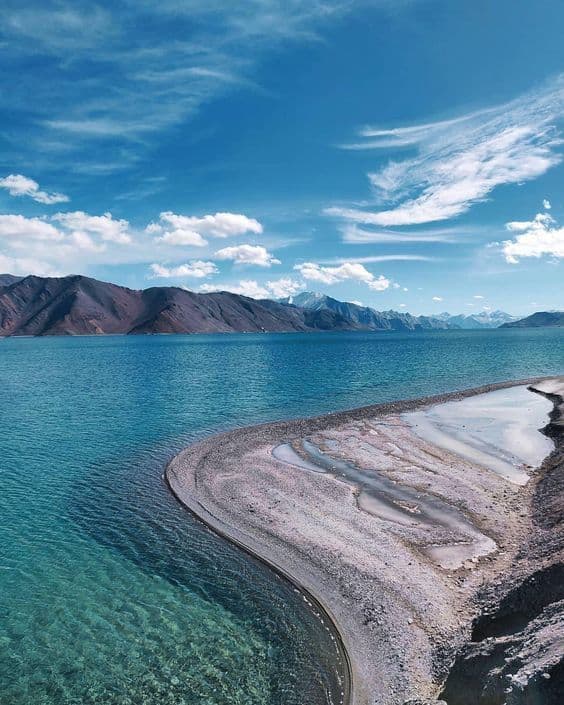
Pangong Tso is about 220 km from Leh and takes five to six hours of mountain driving each way, crossing Chang La at roughly 5,360 m. A same-day return is possible and is a punishing fourteen-hour day; staying one night at the lake is what the trip is actually for. The lake sits at about 4,350 m, nights are cold even in July, and camp accommodation is basic by design. The water changes colour through the day, which is the thing people come for and the reason a night there is worth the discomfort.
The drive, and Chang La
The road from Leh runs east through Karu, then climbs to Chang La — one of the highest motorable passes in the world at about 5,360 m. There is an army post, a small tea stall and a great deal of prayer flags. The advice at the top is to stay no more than twenty minutes: it is nearly two kilometres higher than Leh and the air is thin enough that many people feel it immediately.
Beyond the pass the road descends into the Tangtse valley, passes the permit check post, and runs through Lukung to the western end of the lake at Spangmik, where most accommodation sits. The surface is good in parts and rough in others, and water crossings are normal in summer when snowmelt runs across the road.
Five to six hours is the honest driving time without stops. With a tea break, the pass, the permit check and photographs, allow seven.
Should you stay the night
The same-day return is sold widely and it is the wrong choice for almost everyone. It means leaving Leh around four in the morning, reaching the lake near eleven, having perhaps ninety minutes there in the flattest light of the day, and driving back over Chang La in the afternoon to arrive after dark. Fourteen hours of altitude and mountain road for an hour and a half at the destination.
Staying one night changes the trip entirely. You arrive in the afternoon, see the lake in evening light, wake to it at dawn, and drive back having actually been somewhere. The cost is a cold night at 4,350 m in a tent or a basic room.
| Same day | Overnight | |
|---|---|---|
| Time at the lake | about 90 minutes | afternoon, sunset, dawn |
| Driving | 11-12 hours in one day | split across two days |
| Light | harsh midday only | the colours people come for |
| Night | own bed in Leh | cold, basic, 4,350 m |
What the camps are actually like
Accommodation at Spangmik and the neighbouring hamlets is mostly fixed tents and simple guesthouse rooms. The better tents have a proper bed, an attached bathroom and thick bedding; the cheaper ones have a cot and a shared facility. Electricity is usually solar and limited to a few evening hours, so charge everything before leaving Leh.
There is no heating in most camps. Nights at the lake drop close to freezing even in July and well below in September. The bedding provided is generally adequate and a good sleeping layer of your own is a sensible addition. Hot water is a bucket, delivered on request, at a time rather than on demand.
None of this is a complaint — it is a remote lake in a restricted border area and the infrastructure reflects that. Travellers who arrive expecting a resort are the ones who have a bad night.
The colour, and when to see it
Pangong's reputation rests on the water changing colour — blues from almost turquoise through to deep indigo, with greys and greens depending on cloud and angle. It is a genuine phenomenon rather than a photographic trick, caused by depth, the mineral content of the saline water and the extraordinary clarity of light at that altitude.
It is at its most dramatic in the hours either side of sunrise and sunset, which is precisely what the day trip misses. Midday light flattens it to a uniform blue.
When to go, and the freeze
May to September is the accessible season. June through August are warmest and busiest; September gives clear skies, strong colour and genuinely cold nights.
From around December the lake freezes, despite being saline, and stays frozen into February or March. It is a remarkable sight and reaching it in winter is an expedition rather than a trip — Chang La may be closed, camps are shut, and the cold is severe.
Practicalities
Permits are required and arranged in Leh. Carry multiple photocopies: they are collected at the Tangtse check post. Mobile coverage is limited to BSNL postpaid in patches and should be treated as absent. There are no fuel stations between Karu and the lake, so the vehicle must leave Leh with a full tank and that is worth confirming with the driver rather than assuming.
Carry cash. Card payment is unreliable at the camps and there are no ATMs beyond Leh.
Questions people ask
Can Pangong be done as a day trip from Leh?
Physically yes, and it means eleven to twelve hours of driving for about ninety minutes at the lake in the worst light. One night at the lake is strongly the better trip.
How cold does it get at Pangong?
Close to freezing at night even in July, and well below in September. Most camps have no heating, so bring a warm layer regardless of the month.
Is there mobile network at Pangong?
Treat it as none. BSNL postpaid works in patches; other networks generally do not. Tell people at home you will be out of contact.
Do I need a permit for Pangong?
Yes — an Inner Line Permit for Indian nationals or a Protected Area Permit for foreign nationals, arranged in Leh. Carry several photocopies for the check posts.