
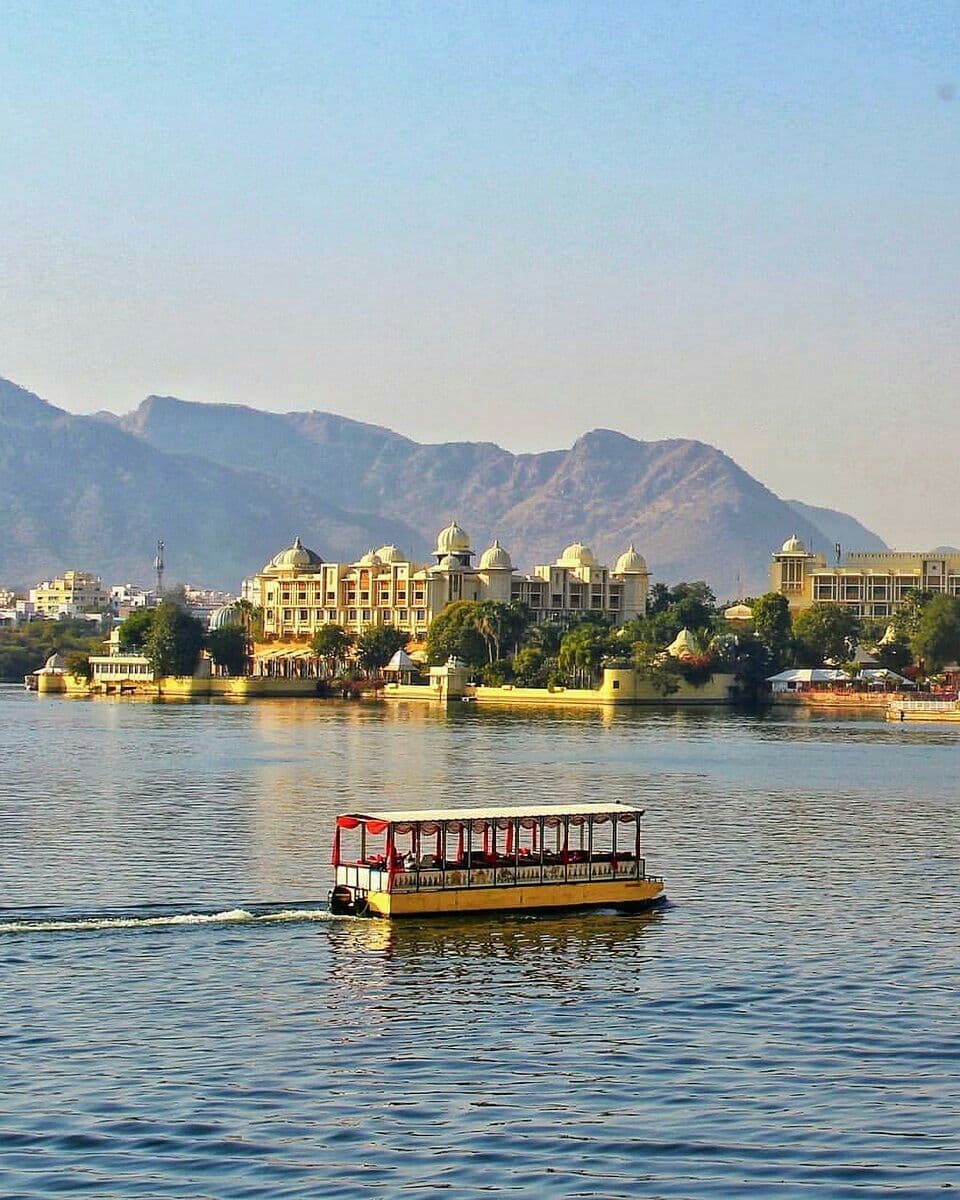
Rajasthan in the monsoon:the trip almost nobody takes
Every page about Rajasthan says October to March, and for Jaisalmer and Bikaner that is right. But the Aravalli south — Udaipur, Mount Abu, Kumbhalgarh, Ranakpur, Chittorgarh — is at its best in the monsoon and it is not close. The hills green up entirely, Udaipur's lakes fill to the point where the city looks the way the photographs promise, Mount Abu is cool and wet, the crowds are a fraction of the winter, and accommodation that costs a fortune in December is reasonable in August. It is the best-value trip in north India and almost nobody takes it.
Updated · Fares from the published rate card, Sedan ₹11/km to Tempo ₹23/km
- Where it works
- The Aravalli south
- Where it does not
- Jaisalmer, Bikaner, Barmer
- The window
- July to mid-September
- Why
- Green hills, full lakes, no crowds, low rates
Rajasthan gets written about as one place and it is two. The Thar in the west — Jaisalmer, Bikaner, Barmer — is desert, and the monsoon barely reaches it. The Aravalli south — Udaipur, Mount Abu, Kumbhalgarh, Ranakpur, Chittorgarh — is hill country, and the monsoon transforms it.
Because the standard advice is written for the desert, the southern half gets lumped in with it and a genuinely excellent season goes unused. The lakes at Udaipur are seasonal; in a dry April they are low and in late August they are full. The Aravalli hillsides are brown for nine months and green for three. Mount Abu, which is in the hills rather than the desert, is better in the rain than in the winter.
What follows is where it works, what the desert is actually like in those weeks, and the itinerary we would run in August.
Rajasthan in the monsoon, region by region
The split runs roughly along the Aravalli line. South and east of it the monsoon is an improvement; west of it, it is not.
| Region | What the monsoon does | Our view |
|---|---|---|
| Udaipur and the lakes | Lakes fill; hills green; mist on the Aravallis | **Go.** The best time of year here |
| Mount Abu | Cool, wet, completely green | **Go.** Its second season and arguably its best |
| Kumbhalgarh and Ranakpur | The fort wall in cloud; forest green | **Go.** Dramatic and empty |
| Chittorgarh | Green hill, fewer visitors | Go. The fort is as good and far quieter |
| Bundi and Kota | Step wells full; Chambal running high | Go. Underrated in any season, best now |
| Jaipur | Humid, intermittent rain, green Aravalli edge | Fine. Nahargarh and Amber look different |
| Ranthambore | **Core zones closed** Jul–Sep | Avoid for safari; Jhirna and Dhela may be open |
| Jodhpur | Humid, little rain | Workable. Mehrangarh is unaffected |
| Bikaner | Little rain, still hot and humid | Not at its best |
| Jaisalmer and Barmer | Little rain; dune light flat under cloud | Not the season. Go in winter |
The monsoon in Rajasthan is July to mid-September, arriving later and more weakly the further west you go. Ranthambore closes its core safari zones through the monsoon, which is the one hard closure in the state and worth checking before building a trip around it.
Udaipur
Why Udaipur in August is a different city
Because the lakes are seasonal. Pichola and Fateh Sagar are fed by monsoon catchment, and the difference between a dry spring and a good August is the difference between a lake with exposed banks and a lake up to the palace walls. Every photograph of Udaipur that looks like the postcards was taken when the water was high.
The hills behind the city green up at the same time, which changes the view from the Monsoon Palace — so named for a reason — from brown ridges to something closer to the Western Ghats. The sunset from up there in late August with cloud over the Aravallis is among the better hours available anywhere in Rajasthan.
The practical advantages are substantial too. Rooms that are booked out and expensive in November and February are available and reasonable in August. The City Palace at opening has a fraction of the winter queue. The boat on the lake is not a scrum.
What you trade is certainty: an outdoor dinner can be rained off, and a few hours of heavy rain will keep you indoors. On a three-night stay that is a reasonable trade.
Mount Abu
The one place in Rajasthan that is a hill station, and behaves like one
Mount Abu inverts the state calendar entirely. Its peak is April to June, because it is the cool option when the plains are unbearable, and its second season is the monsoon — when the plateau is in cloud, the hillside is completely green, and the temperature is pleasant rather than merely tolerable.
It is also the one Rajasthan destination where the monsoon affects the driving rather than just the weather. The 27 km hairpin ascent from Abu Road takes an hour in dry conditions and longer in heavy rain, and the ghat wants a vehicle with decent engine braking. That is an argument for the Ertiga or Innova rather than against the trip.
Dilwara, which is the main reason to be there, is indoors — and its marble carving in the diffuse light of an overcast day is arguably better than in harsh sun. The restriction on non-worshipper hours and the photography ban inside apply in any season.
The itinerary
The five-day southern Rajasthan trip we would run in August
**Day one: Udaipur.** Fly or drive in. The City Palace in the afternoon, the Monsoon Palace for sunset if the cloud allows, Bagore ki Haveli in the evening.
**Day two: Udaipur.** Jagdish temple and the old town in the morning, a boat on Pichola when the water is high, Fateh Sagar and the Saheliyon ki Bari gardens — which are at their best in rain, being water gardens.
**Day three: Kumbhalgarh and Ranakpur.** Eighty-five and ninety kilometres out respectively. The thirty-six kilometre fort wall with cloud on the ridge is the single most dramatic thing in the state in this season, and Ranakpur's 1,444 marble pillars are indoors. Remember Ranakpur admits non-Jain visitors only from noon.
**Day four: Mount Abu.** A hundred and sixty-five kilometres and three and a half hours including the ghat. Dilwara in the afternoon, Nakki Lake, and Guru Shikhar if the cloud lifts.
**Day five: back, or on to Ahmedabad.** Udaipur is 165 km back; Ahmedabad is 225 km south if you are flying out from there.
A sedan bills ₹16,500 for the five days on the 300 km per day minimum; an Innova ₹27,000, and in this season on these roads the Innova is the one we would recommend.
The honest costs
What you give up, and the one closure to check
**Ranthambore closes its core safari zones** through the monsoon, roughly July to September. Jhirna and Dhela at Corbett stay open year round but Ranthambore's main zones do not, so a trip built around a tiger safari is the one Rajasthan itinerary the monsoon genuinely blocks. Check before booking rather than after.
**The desert is not at its best.** Jaisalmer gets little rain so it is not wet, but the dune light that people travel for is a winter phenomenon and the humidity makes the heat worse rather than better. If Jaisalmer is the point of your trip, go in winter.
**Outdoor plans need alternatives.** A few hours of heavy rain will keep you in, and an outdoor dinner or a sunset viewpoint can be lost. On a five-day trip that costs you a couple of hours; on a two-day trip it can cost the main thing you came for.
**Some ghat roads are slower.** The Abu Road ascent and the Kumbhalgarh approach both take longer in heavy rain. It is not Himachal-level landslide risk — these are not gorge roads — but a spare half-day is sensible.
Three things the drivers would tell you
South and east of the Aravallis, not west
Udaipur, Mount Abu, Kumbhalgarh, Chittorgarh and Bundi are better in the monsoon. Jaisalmer and Bikaner are not.
Check Ranthambore before you build around it
The core safari zones close roughly July to September. It is the one hard closure in the state.
Take the Innova for the ghats
The Abu Road ascent and the Kumbhalgarh approach both want engine braking in the wet. This is the season for the bigger vehicle.
Udaipur's lakes are seasonal
Full in late August, low in a dry spring. The city that looks like the photographs is the monsoon one.
Book three nights, not one
A few hours of rain costs a two-day trip its main event and a five-day trip a couple of hours. Length is the insurance.
Questions people ask
Frequently asked questions
Our team is here to help. Contact us for personalized assistance.
