Chandigarh is about 245 km from Delhi and four to five hours by road, and is the only Indian city planned entirely from nothing by a single architect — Le Corbusier, from 1951. A day and a half covers it: the Rock Garden and Sukhna Lake on one afternoon, the Capitol Complex and the Rose Garden the next morning. The Capitol Complex is a UNESCO World Heritage site and requires advance registration with photo identification, on guided tours at fixed times — it cannot simply be walked into.
A city built on a grid
After Partition left Punjab without a capital, Nehru commissioned a new one and the job went to Le Corbusier. What he produced is a city of numbered sectors, each roughly 800 by 1,200 metres, each intended to be self-sufficient with its own market, school and green space, separated by wide roads on a hierarchy from fast arterials down to residential lanes.
Visitors notice two things immediately. It is startlingly green — a vast proportion of the land is parks and verges. And it is not a walking city: the sectors are large, the distances between them real, and crossing town means a vehicle.
Whether the plan succeeded is genuinely argued. It is among the cleanest and best-ordered cities in India with high quality of life. It is also sometimes called sterile, and the grid that works for cars works less well for the street life that defines older Indian cities. Both are fair.
The Rock Garden, which should not exist
The best thing in Chandigarh was built illegally.
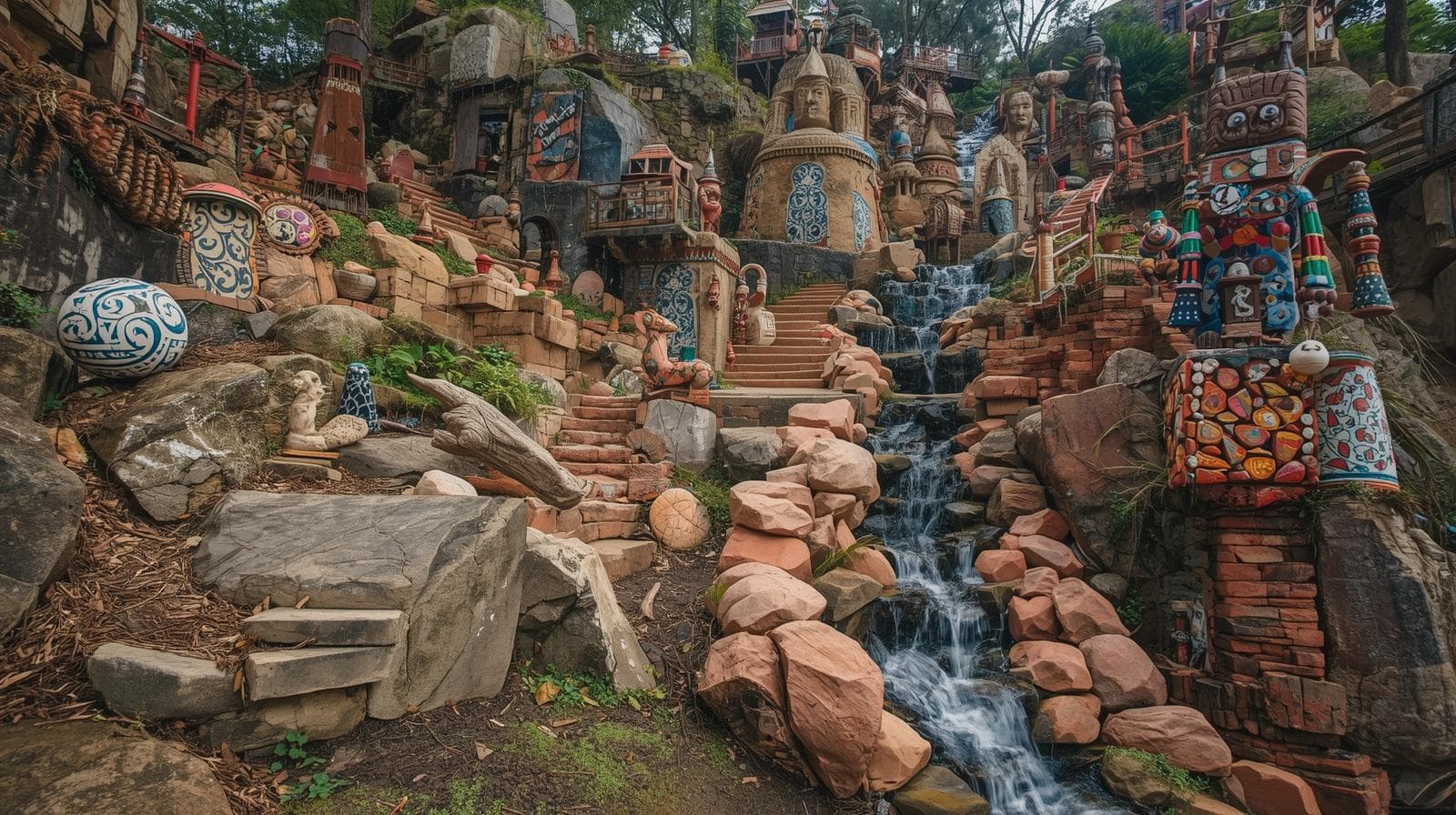
Nek Chand, a roads inspector, began secretly collecting construction debris, broken crockery, bangles, tiles and bottle caps in the 1950s and building sculptures in a forest gorge on government land. He worked alone and unauthorised for about eighteen years. When officials found it in 1975 it covered twelve acres and was technically an encroachment that should have been demolished.
Public feeling saved it. Nek Chand was given a salary and a workforce, and the garden now covers some forty acres: courtyards of ceramic-shard figures, mosaic waterfalls, archways you stoop through into further chambers, and thousands of sculptures made from waste.
It takes a good two hours and it is genuinely unlike anything else. Go early — it is popular and the narrow passages bottleneck badly once it fills.
| Where | Note | |
|---|---|---|
| Afternoon one | Rock Garden, then Sukhna Lake | Go to the garden early; lake at sunset |
| Morning two | Capitol Complex guided tour | Register in advance, carry photo ID |
| Late morning | Rose Garden (Sector 16) | Best Feb-Mar; vast |
| Afternoon | Sector 17 plaza, Government Museum | Or drive on to Kasauli / Shimla |
The Capitol Complex, and the paperwork
The Capitol Complex — the Secretariat, the Legislative Assembly, the High Court and the Open Hand monument — is Le Corbusier's set piece and a UNESCO World Heritage site, and it is where the architecture is at its most uncompromising: raw concrete, enormous scale, the famous ramps and brise-soleil.
It is also an active seat of government in a sensitive area near the Punjab–Haryana border, so access is controlled. Visits are by guided tour at fixed times, require advance registration, and photo identification is checked. Foreign nationals face additional requirements.
This catches people out constantly. Confirm the current procedure and timings before building a morning around it, because turning up is not an option.
The Open Hand, a giant rotating metal sculpture, is Chandigarh's emblem and Le Corbusier's symbol of being "open to give, open to receive".
Sukhna and the Rose Garden
Sukhna Lake is a man-made reservoir at the foot of the Shivaliks with a long promenade. Early morning and sunset are when the city uses it, and it is the most pleasant hour in Chandigarh — joggers, rowers, and the hills behind.
The Zakir Hussain Rose Garden in Sector 16 is among the largest in Asia, with thousands of rose varieties across thirty acres. It is at its best in February and March and hosts the Rose Festival; outside that window it is a large pleasant park rather than a spectacle.
Using it as a base
Chandigarh's real strategic value to a traveller is as the gateway to Himachal. Kasauli is two hours, Shimla three and a half, Manali seven to eight, Dharamshala about six.
That makes the sensible pattern: fly or train into Chandigarh, see the city in a day, and drive up. Triveni Cabs runs all of those routes from Chandigarh, and starting a hill trip here rather than from Delhi removes four to five hours of plains driving at each end.
October to March is comfortable; summer is hot and flat. Monsoon is pleasant and the Shivaliks go green.
Questions people ask
Do I need permission for the Capitol Complex?
Yes. Visits are by guided tour at fixed times with advance registration and photo identification checked at entry, with extra requirements for foreign nationals. You cannot turn up.
How long does Chandigarh need?
A day and a half. The Rock Garden alone takes two hours and deserves them.
Is the Rock Garden worth it?
It is the best thing in the city — forty acres of sculpture built illegally from waste over eighteen years by one man. Go early, before the narrow passages fill.
Is Chandigarh a good base for the hills?
The best one. Kasauli is two hours, Shimla three and a half, Manali seven to eight — all with far less plains driving than starting from Delhi.