Dalhousie is a small colonial hill station at about 1,970 m in Chamba district, roughly 560 km from Delhi and a long day's drive of eleven to twelve hours. It is quieter and less developed than Shimla or Manali, built across five hills with Scottish and Victorian churches and walking paths rather than attractions. Khajjiar, 22 km away, is the saucer-shaped meadow ringed by deodar that gets called India's mini Switzerland — worth half a day, and more honestly described as a very pretty meadow with ponies and paragliding than as an Alpine valley.
What Dalhousie is, and is not
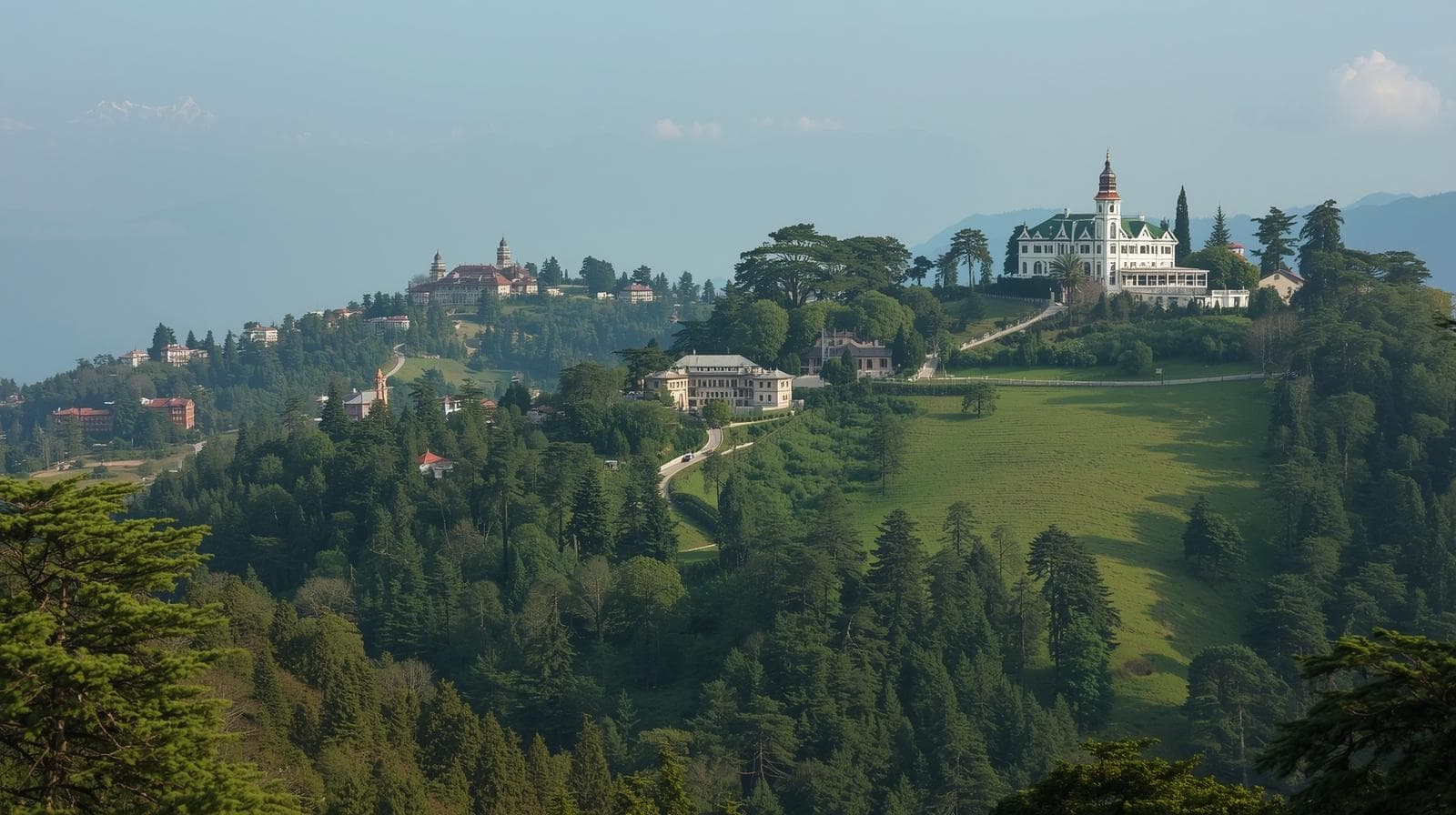
Dalhousie was established in 1854 as a British summer retreat and named after the Governor-General. What survives is the shape of that: five low hills — Kathlog, Potreyn, Tehra, Bakrota and Balun — linked by level walking roads cut around the contours, with churches, a mall and bungalows scattered through deodar forest.
It has very little in the way of attractions in the conventional sense. There is no fort, no major temple, no lake. What it has is walking: the Garam Sadak and Thandi Sadak loops around Potreyn hill, the Bakrota rounds with views towards the Pir Panjal, and a chain of small churches — St John's, St Francis', St Patrick's — built in the 1860s and 1890s.
This makes Dalhousie a particular taste. Travellers who want to be occupied find it dull; travellers who want to walk in pine forest for three days and read in the afternoons find it close to perfect. It is substantially quieter than Shimla in every season.
| Morning | Afternoon | |
|---|---|---|
| Day one | Arrive; the Mall and Gandhi Chowk | Garam Sadak and Thandi Sadak walking loop, St John's Church |
| Day two | Khajjiar, 22 km — meadow, lake, Khajji Nag temple | Kalatop sanctuary on the way back |
| Day three | Dainkund Peak for the ridge walk | Panchpula and the Satdhara springs, or onward to Chamba |
Khajjiar, and the Switzerland question
Khajjiar is a roughly circular meadow about 1.2 km across at 1,950 m, enclosed on all sides by dense deodar forest, with a small lake at its centre and the twelfth-century Khajji Nag temple at its edge. The "mini Switzerland of India" label comes from a Swiss diplomat's remark in the 1990s and has been attached to it ever since.
Set the label aside and it is genuinely lovely — the enclosure of the meadow by tall deodar is unusual, and on a clear morning before the crowds arrive it is one of the prettiest places in Himachal. Set the label beside the actual Alps and it does not survive the comparison, and visitors who arrive expecting that are disappointed.
It is also a managed attraction. Zorbing, paragliding, pony rides and food stalls occupy the meadow edge through the season, and on a summer weekend it is busy. Arriving by nine in the morning is the difference between a quiet meadow and a fairground.
Kalatop and Dainkund
Kalatop Wildlife Sanctuary sits between Dalhousie and Khajjiar and is the best forest walking in the area — dense deodar and oak, a marked trail from the forest rest house, and a reasonable chance of seeing barking deer or Himalayan black bear signs. Entry is through a checkpost and the road through it is unsurfaced in places.
Dainkund Peak at about 2,745 m is the highest point near Dalhousie and the one place with a genuine panorama — the ridge walk from the road head takes about twenty minutes to the Pholani Devi temple, with the Ravi, Beas and Chenab valleys visible on a clear day. It is frequently in cloud, which is worth knowing before driving up.
When to come
March to June is the main season: rhododendron in spring, then comfortable summer days while the plains are at their worst. July to September is monsoon — landslides on the approach roads are common and the views are mostly cloud.
October and November are the clearest months and the quietest good ones. December to February brings snow, with Khajjiar under it some years and the Dainkund road often closed; Dalhousie itself stays accessible and is very quiet.
Getting there
Dalhousie is about 560 km from Delhi, which is eleven to twelve hours of driving and genuinely a full day — the last 80 km from Pathankot is mountain road. Most travellers break the journey or take an overnight train to Pathankot and drive the final three hours.
It also pairs naturally with Dharamshala, about 120 km and four hours away, and with Chamba, 56 km down the valley. Triveni Cabs covers the route from Delhi and from Chandigarh, which at about 330 km is the more comfortable starting point.
Questions people ask
Is Khajjiar really like Switzerland?
It is a genuinely beautiful enclosed meadow ringed by deodar, and the comparison is a tourism label rather than a description. Go early, enjoy it on its own terms, and the disappointment does not arise.
How many days does Dalhousie need?
Two to three. It is a walking destination rather than a sightseeing one, and the pleasure is in not rushing it.
Is Dalhousie better than Shimla?
Much quieter and much less developed, with fewer things to do. Better if you want forest walks and churches; worse if you want restaurants, shopping and activity.
Can Khajjiar be visited from Dharamshala?
It is about 120 km and four hours each way, so possible but a long day. Staying a night in Dalhousie is the better arrangement.