
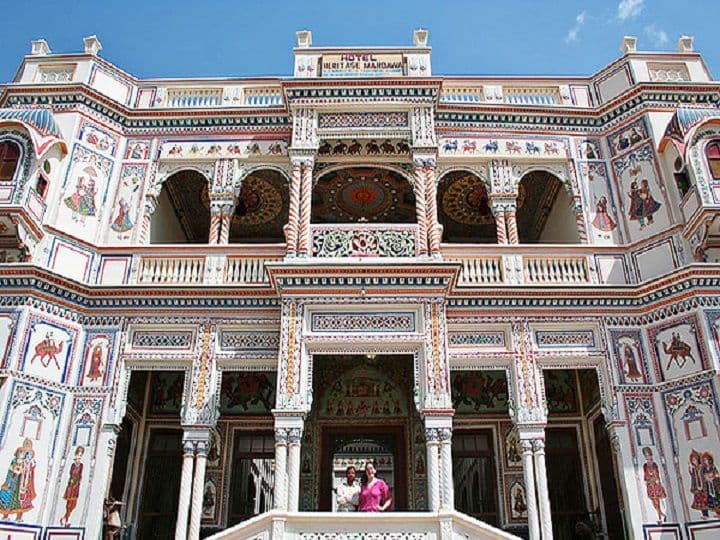
Shekhawati is a region, not a town — a cluster of small Rajasthani settlements between Delhi and Bikaner whose merchant families covered their mansions in painted frescoes through the eighteenth and nineteenth centuries. It is often called the world's largest open-air art gallery. Mandawa, Nawalgarh and Fatehpur are the three towns worth the time, and two days covers them. Mandawa is about 260 km from Delhi and 170 km from Jaipur, which makes the region a natural detour rather than a destination in itself.
What Shekhawati actually is
In the eighteenth and nineteenth centuries the Marwari trading families of this region grew extremely rich on the caravan routes between the ports of Gujarat and the markets of the Gangetic plain. They built mansions — havelis — in their home towns and competed with one another by covering every available surface, inside and out, with painted frescoes.
The subjects are the record of a world changing fast. Early work is mythological: Krishna, Rama, processions of elephants. Later work, as the merchants travelled and the railways arrived, turns to motor cars, hot-air balloons, gramophones, Europeans in hats, and aeroplanes painted by artists who had clearly never seen one. The result is a region of several thousand painted buildings, almost none of it in a museum.
The merchants then left. The caravan routes died when the railways and the ports reorganised trade, and the families moved to Bombay and Calcutta where their descendants built modern India's largest business houses. The havelis stayed, mostly shut, and the paint has been weathering ever since.
| Town | Distance from Mandawa | What it is best for |
|---|---|---|
| Mandawa | — | The most visited; best accommodation, a fort hotel, frescoes in good condition |
| Nawalgarh | about 30 km | The finest single havelis — Poddar and Morarka, both properly maintained museums |
| Fatehpur | about 25 km | The most atmospheric decay, plus the restored Nadine Le Prince haveli |
Mandawa
Mandawa is the usual base because it has the accommodation — including the fort, which operates as a heritage hotel — and because its havelis are clustered tightly enough to walk between. The Murmuria, Goenka and Chokhani havelis are the ones most often opened, usually by a caretaker who appears with keys and expects a tip, which is the normal arrangement throughout the region.
It is also the most touristed of the three, which in Shekhawati terms means you will see perhaps a dozen other visitors rather than none.
Nawalgarh
If you see only one town, make it Nawalgarh. The Poddar Haveli Museum is the most thoroughly restored building in the region and gives you a sense of how overwhelming the painted interiors originally were — every wall, every ceiling, every door surround. The Morarka Haveli nearby is similarly maintained.
Both charge entry and both are worth it. The contrast with the unrestored havelis in the surrounding lanes is the point: you see what the region looked like, and then what has happened to most of it.
Fatehpur
Fatehpur is where the decay is most visible and, for some visitors, most affecting. Many havelis stand empty with their frescoes fading, doors padlocked, pigeons in the upper rooms. The exception is the Nadine Le Prince haveli, bought and restored by a French artist in the 1990s and open as a cultural centre — the clearest demonstration available of what restoration can recover.
How to see it
A car is essential. The towns are 25 to 30 km apart on rural roads with no useful public transport between them, and the havelis within each town are found by wandering rather than by signage. A local guide in Mandawa or Nawalgarh costs little and is genuinely worth it — they know which caretakers have keys and which buildings are open on which days.
Two days is right: one for Mandawa and Fatehpur, one for Nawalgarh. A single long day is possible and means seeing three towns at a pace that defeats the purpose.
The region works well as a stop between Delhi and Bikaner or Jaisalmer, which is how most travellers reach it. Triveni Cabs covers the route; from Jaipur it is about three hours.
When to come
October to March, without qualification. Shekhawati is open desert country and the summer is severe — walking lanes between havelis at 44°C is not a sightseeing activity. Winter days are mild and the light is good for photographing faded paint, which is the thing most visitors come to do.
Questions people ask
Is Shekhawati worth a detour?
If painted architecture or social history interests you, it is one of the most unusual places in Rajasthan and almost empty of visitors. If you want forts and palaces, Jaipur and Jodhpur serve better.
Which town should I choose if I only have one day?
Nawalgarh. The Poddar and Morarka havelis are properly restored and show what the region originally looked like.
Can I go inside the havelis?
Some are museums with entry fees. Many others are opened by a caretaker with keys who expects a small tip — that is the normal arrangement and worth carrying change for.
How far is Shekhawati from Delhi?
Mandawa is about 260 km, roughly five hours, and about 170 km or three hours from Jaipur.


