
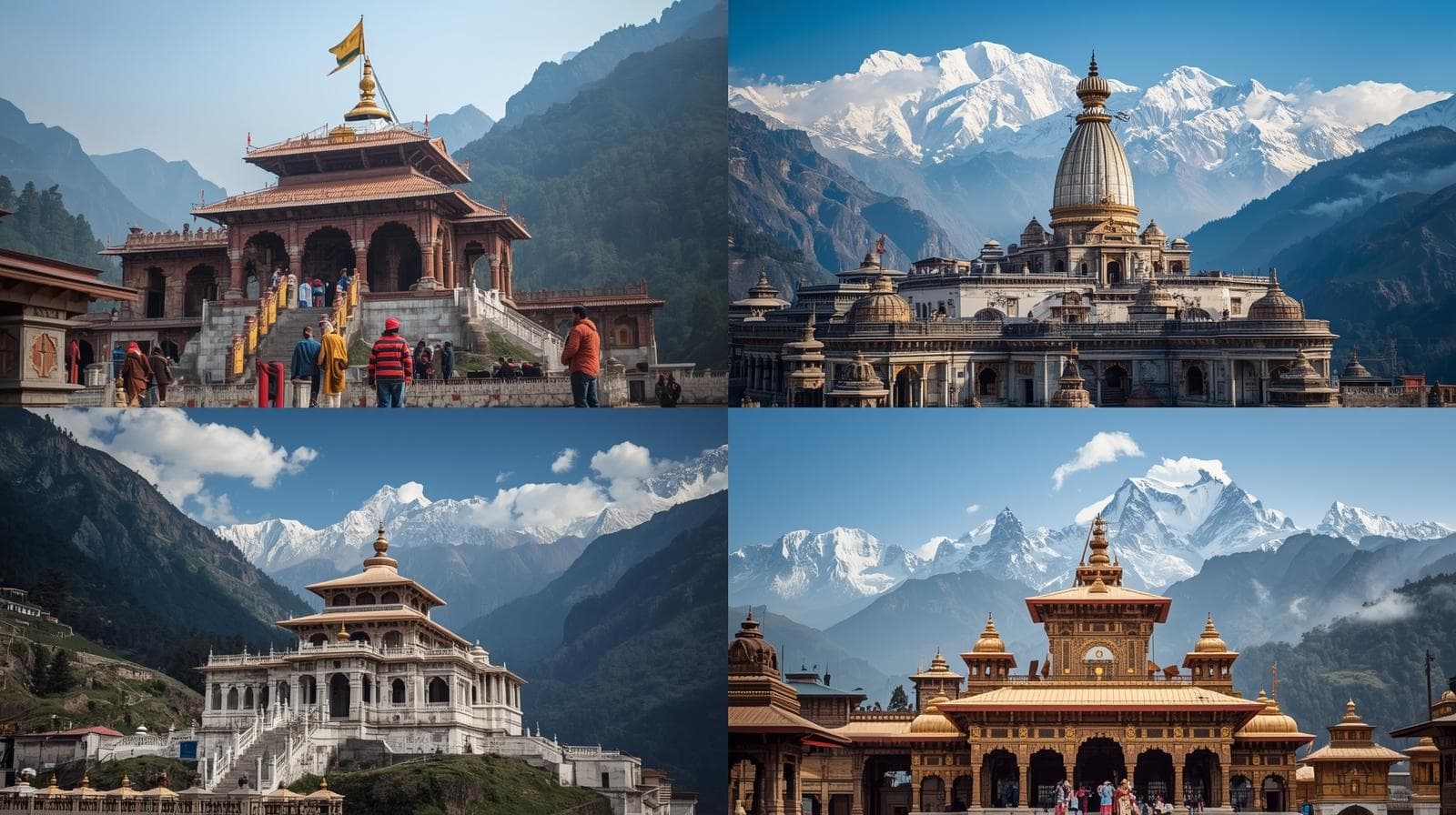
What does Char Dham by car cost?The four parts of the bill, not just the cab
The cab is the part we can quote exactly: a twelve-day Char Dham circuit from Haridwar is ₹39,600 for a sedan, ₹54,000 for an Ertiga, ₹64,800 for an Innova Crysta and ₹82,800 for a 12-seater Tempo Traveller, on the published rate card. That is the vehicle, the fuel, the driver and GST for the whole yatra. But it is roughly half of what a family actually spends, because the Kedarnath ascent, the extras at actual and twelve nights of accommodation are the other half — and the Kedarnath decision alone can swing the total by a large margin.
Updated · Fares from the published rate card, Sedan ₹11/km to Tempo ₹23/km
- Sedan, 12 days
- ₹39,600
- Innova Crysta, 12 days
- ₹64,800
- Not in the fare
- Ponies, helicopter, stays, the 4 extras
- Biggest variable
- How you reach Kedarnath
This page gives a total rather than a fare, which means including costs that do not come to us. Ponies and palanquins at Yamunotri and Kedarnath are paid to the operators at the trailhead. The Kedarnath helicopter is booked separately. Accommodation at Kedarnath, Badrinath and Guptkashi is yours to arrange. We would rather set all of it out than quote the cab and let the rest arrive as a surprise at 3,583 metres.
The one number that moves the total most is how you reach Kedarnath. Walking 16 km costs nothing but two days and a great deal of effort. Ponies for a family of four is a substantial figure. The helicopter is more again, and it is weather-dependent, so it is a cost that can be incurred and then not delivered.
Everything below is for the twelve-day circuit from Haridwar covering all four shrines. The seven-day Do Dham version — Kedarnath and Badrinath only — is roughly 60% of the cab cost and most of the Kedarnath cost, because Kedarnath is where the money goes either way.
The four parts of a Char Dham bill
Only the first row is a figure we set. The rest is set by third parties, and the third row is where a family's total most often differs from its plan.
| Part of the bill | Paid to | What it covers and what moves it |
|---|---|---|
| 1. The cab, 12 days | Triveni Cabs | Sedan ₹39,600 · Ertiga ₹54,000 · Innova Crysta ₹64,800 · Tempo Traveller ₹82,800. Vehicle, fuel, driver and GST. Fixed before you travel. |
| 2. The four extras | Authorities and the driver | Tolls, parking, Uttarakhand entry and the driver night allowance for eleven nights away. Charged at actual; we estimate them upfront on request. |
| 3. Reaching the shrines | Trailhead operators / heli operator | The big variable. Yamunotri is a 6 km walk with ponies and palanquins available; Kedarnath is 16 km with ponies, palanquins or a helicopter from Phata, Sersi or Guptkashi. Gangotri and Badrinath have road to the temple and cost nothing extra. |
| 4. Stays and meals | Hotels and dharamshalas | Eleven nights, two of them at altitude. Kedarnath accommodation is limited and prices accordingly in the May-June peak. Entirely yours to arrange. |
Cab fares are the published rate card times 300 km per day for twelve days. We do not publish figures for row three because pony, palanquin and helicopter rates are set by the operators and the state and change season to season — ask us close to your dates and we will tell you the current position rather than a stale number.
The cab
Why twelve days bills 3,600 km when the yatra drives 1,600
Because Char Dham is the clearest case on the whole site of hiring a vehicle for a period rather than buying kilometres. The circuit covers about 1,600 km of driving over twelve days, and the 300 km per day minimum bills 3,600 — which looks like a large gap until you look at what the car does.
Three of the twelve days the car does not move at all. On the Yamunotri day it waits at Jankichatti while you walk. On the two Kedarnath days it waits at Gaurikund, overnight, while you are at the shrine. Several other days are short valley legs of 100 to 165 km on roads that take four to five hours.
The driver is away from Haridwar for eleven nights, at altitude, on roads he cannot leave. The alternative to a minimum is a bill that prices a day of waiting at Gaurikund the same as a day of driving 500 km, which no operator can actually honour — they recover it in the extras instead. The minimum is the version where you can see it.
Kedarnath
The decision that moves the total most
Sixteen kilometres from Gaurikund with a 1,500 metre gain. Walking costs nothing and takes six to eight hours up, four to six down, which is why the itinerary allows two days for it. For a fit adult it is the best part of the yatra; for an older pilgrim it is not realistic.
Ponies and porters are available at Gaurikund and are the standard choice. The rate is set at the trailhead and rises sharply in the May and June peak, and for a family of four it is a substantial line in the budget — comparable to several days of the cab. Palanquins carried by four bearers cost more again and are the option for those who cannot sit a pony.
The helicopter flies from Phata, Sersi or Guptkashi to the Kedarnath helipad in minutes. It is the most expensive option by a clear margin, booked separately and well ahead, and it is weather-dependent — flights are grounded regularly and a booking is not a guarantee of flying. A great many families fly up and walk down, which halves the cost and the uncertainty.
The honest planning advice is to decide this first and budget it before anything else, because it is both the largest variable and the one that determines how many days the yatra needs.
Cheaper versions
Do Dham, and the other honest ways to reduce the total
Do Dham — Kedarnath and Badrinath only — is the main one. Seven days from Haridwar instead of twelve, about 950 km of driving, and a sedan bills ₹23,100 against ₹39,600. It drops Yamunotri and Gangotri, which is a real loss, but it keeps the two most visited shrines and the Kedarnath walk intact.
Sharing the vehicle is the other big lever. A 12-seater Tempo Traveller at ₹82,800 for twelve days is ₹6,900 per head across twelve people, against ₹39,600 for a sedan carrying two at ₹19,800 each. For an extended family travelling together the larger vehicle is dramatically cheaper per person, not more expensive.
Travelling in September rather than May is the third. Accommodation at Kedarnath and Badrinath and the pony rates at Gaurikund are both materially lower outside the May and June peak, the roads are quieter, and the weather is in most respects better. The caveat is that the season closes earlier at altitude.
What we would not recommend as an economy is compressing the days. Twelve is not padding — three of them are days the car waits while you walk, and cutting them means either skipping a shrine or attempting the Kedarnath ascent and descent in one day.
What to ask
Getting a figure you can actually plan against
Ask for the cab fare and the four extras together as a stated estimate. The fare is exact; the tolls, Uttarakhand entry and eleven nights of driver allowance are knowable within a reasonable margin, and we will put a figure on them rather than leaving "at actual" to be discovered.
Ask what the current pony, palanquin and helicopter position is for your dates. We do not set those rates and we will not quote stale ones, but we run the route weekly through the season and can tell you where they stand close to your travel date.
And decide the Kedarnath method before you book the car, because it changes the shape of the itinerary as well as the budget. A family flying up and walking down needs a different day-seven plan from one walking both ways.
Three things the drivers would tell you
Budget Kedarnath first
It is the largest variable in the whole yatra and it decides the number of days as well as the cost. Everything else can be planned around it.
A helicopter booking is not a flight
Kedarnath flights are grounded regularly by weather. Plan the days so a cancellation means walking rather than missing the shrine, and treat the fare as a cost that may not deliver.
Share the vehicle, not the days
A Tempo Traveller across twelve people is far cheaper per head than sedans. Compressing the twelve days is not an economy — three of them are days the car waits while you walk.
September over May
Accommodation and pony rates are both materially lower outside the May and June peak, and the roads are quieter. The season simply closes earlier at altitude.
Register before you travel
Uttarakhand yatra registration is required and checked on the route. Doing it online beforehand avoids the Haridwar and Rishikesh counters, which are slow in the peak.
Questions people ask
Frequently asked questions
Our team is here to help. Contact us for personalized assistance.
Where to go next
