Fatehpur Sikri is 40 km from Agra, about an hour by road, and is a UNESCO World Heritage site built by Akbar from 1571 and abandoned within about fifteen years. It has two distinct halves with separate entry arrangements: the palace complex, which is ticketed, and the Jama Masjid with the Salim Chishti dargah, which is an active place of worship and free. Two to three hours covers both. It pairs naturally with Agra or with a Bharatpur stop on the way to Jaipur.
Why it was abandoned
Akbar built Fatehpur Sikri as his capital after the Sufi saint Salim Chishti, living at Sikri, foretold the birth of the son Akbar had long wanted. The son — later Jahangir — was born in 1569, and the emperor moved his court to a new city raised on the ridge above the saint's dwelling.
It was occupied for roughly fifteen years and then left. The usual explanation is water: the lake that supplied the city proved inadequate. Historians also point to Akbar's campaigns in the north-west drawing the court to Lahore, and the two explanations are not exclusive.
The result is a complete Mughal city, built at once in a single architectural moment and never altered by later occupation — which is exactly what makes it unusual. Most Mughal sites are layered; this one is a snapshot.
| What it is | Entry | |
|---|---|---|
| Palace complex | Diwan-i-Khas, Panch Mahal, Jodha Bai's palace, Birbal's house | Ticketed |
| Jama Masjid & dargah | Buland Darwaza, Salim Chishti's tomb | Free, active worship |
The palace complex
Panch Mahal is the five-storey open pavilion, each level smaller than the one below, with 176 carved columns on the ground floor and no two alike. It was a pleasure pavilion catching the evening breeze and it is the most photographed structure here.
Diwan-i-Khas contains the single most remarkable room: a central carved pillar flaring into a great lotus capital, from which four stone bridges run to the corners of the upper gallery. Akbar is said to have sat on the capital while representatives of different faiths debated from the corners — the setting for the religious discussions that produced his Din-i-Ilahi.
Jodha Bai's Palace is the largest residential block, and Birbal's House the most finely carved. The Pachisi court, laid out in stone in a courtyard, is where the game was played with people as pieces.
Buland Darwaza and the dargah
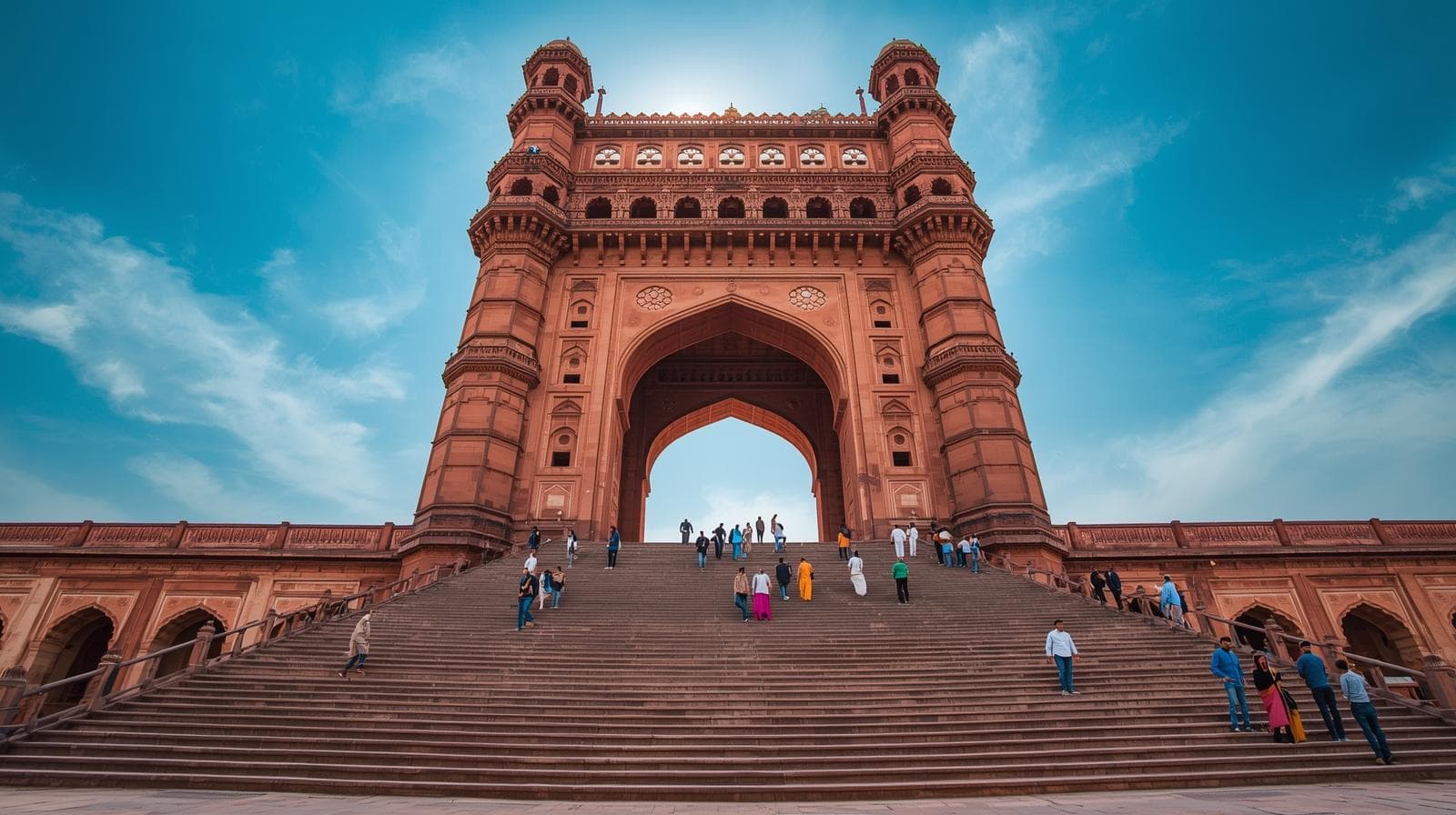
The Buland Darwaza is a 54-metre gateway raised to mark Akbar's Gujarat campaign, and it is among the tallest gateways in the world. The approach up its steps is the most dramatic arrival at any Mughal site, and the inscription on it includes the saying attributed to Jesus: *"The world is a bridge, pass over it, but build no house upon it."*
Inside the courtyard stands the tomb of Salim Chishti in white marble, surrounded by some of the finest jali screens in India — stone carved to a lace-like thinness. Visitors tie threads to the screens as petitions, which is why the marble is covered in them.
It is an active dargah. Heads are covered, shoes are left, and it should be approached as a working shrine rather than a monument.
The practical warnings nobody gives
Three things catch visitors out here more than at any comparable site.
Shoes at the mosque. The Jama Masjid courtyard is enormous and the stone gets extremely hot from spring onwards. Shoes are left at the gate and the walk across is long. Carry socks — thick ones. This single item makes more difference to the visit than anything else.
Unofficial guides. The approach and the gateway attract persistent offers. Official ASI-approved guides exist and carry identification; the rest will quote one figure and ask another at the end. Agree the price and the duration in writing on a phone screen before starting, or decline clearly and keep walking.
The shuttle. Private vehicles stop at a car park and a shuttle covers the last stretch. Factor it into the timing.
Fitting it in
From Agra it is 40 km and about an hour. The standard and sensible arrangement is the Taj at sunrise, Agra Fort mid-morning, Fatehpur Sikri in the afternoon.
It also sits conveniently on the road from Agra to Jaipur, which makes a three-part day: Fatehpur Sikri in the morning, the Keoladeo bird sanctuary at Bharatpur 35 km on, and Jaipur by evening.
October to March is comfortable. The site is open sandstone with almost no shade; May and June afternoons are genuinely punishing and the mosque courtyard becomes unwalkable.
Questions people ask
How far is Fatehpur Sikri from Agra?
About 40 km, an hour by road. Most visitors do it as an afternoon after the Taj and Agra Fort in the morning.
Why was Fatehpur Sikri abandoned?
Most commonly attributed to an inadequate water supply, with Akbar's north-western campaigns drawing the court to Lahore as a contributing reason.
Do I need to pay for both parts?
The palace complex is ticketed. The Jama Masjid and the Salim Chishti dargah are an active place of worship and free to enter.
What should I bring?
Thick socks. Shoes come off at the mosque and the courtyard stone is very hot from spring onwards — it is the single most common complaint about the visit.