
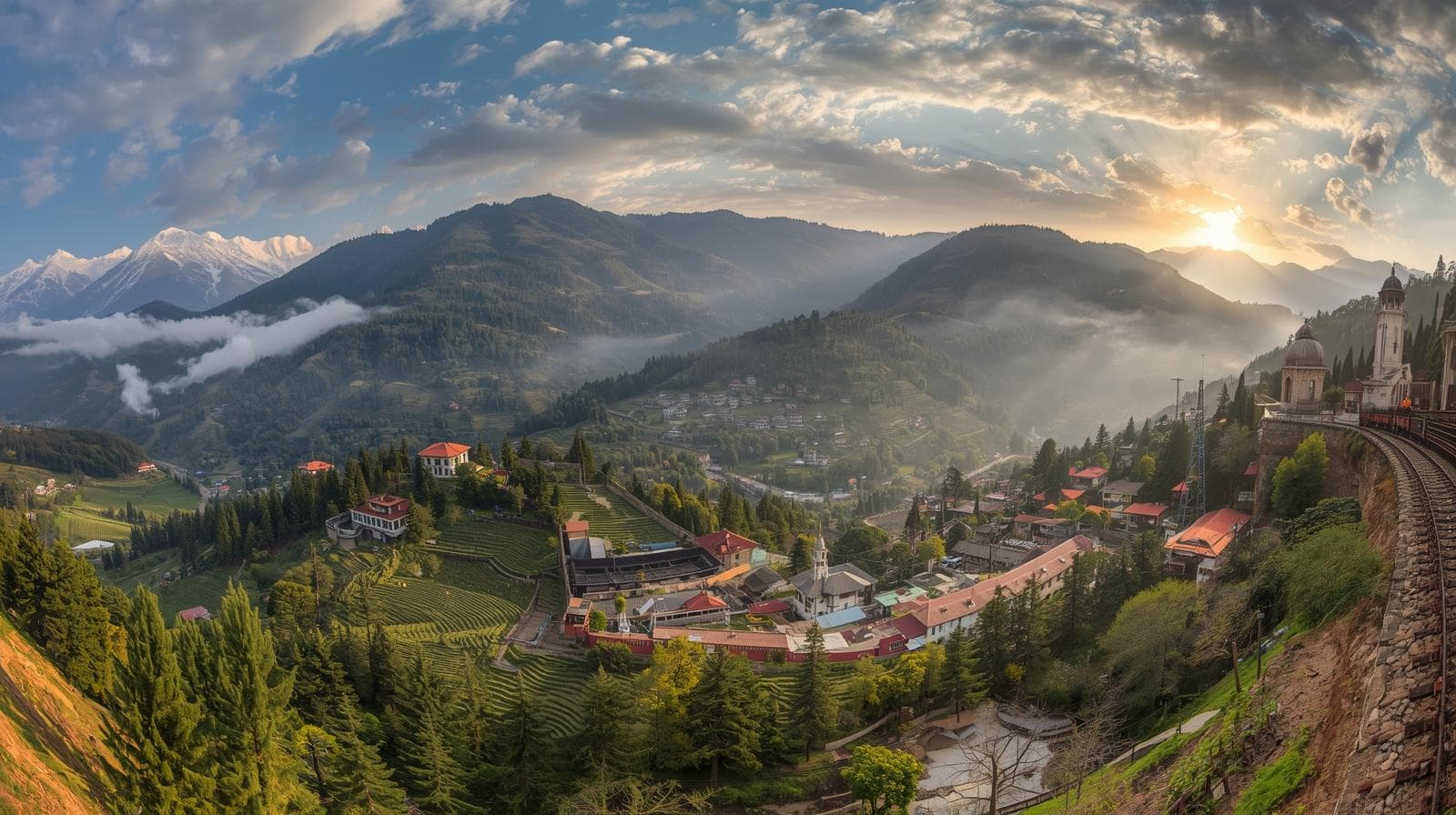
The Kalka–Shimla railway is a 96 km narrow-gauge line opened in 1903, a UNESCO World Heritage site, and it climbs about 1,500 m through 102 tunnels and over 800 bridges. It takes five to six hours — roughly twice as long as the taxi. The Shivalik Deluxe Express and the Himalayan Queen are the trains to look for, tickets sell out well ahead in season, and the honest position is that this is a journey you take for its own sake, not a way of getting to Shimla.
Why it takes five hours to cover 96 km
The line was built to carry the British administration to its summer capital, and the engineering constraint was gradient. A narrow-gauge track climbing 1,500 m cannot go straight, so it loops, doubles back and tunnels — 102 tunnels on the current count, the longest at Barog running 1,143 m.
The result is an average speed of under 20 km/h and a journey that is all view: deodar forest, valley drops, the track visible below you where you were twenty minutes ago, and small stations with names on enamel boards that have not changed in a century.
The Barog tunnel carries the story people repeat — Colonel Barog began boring from both ends, the bores failed to meet, he was fined and, by the account, shot himself. The tunnel was rebuilt by someone else and the station kept his name.
| Train | Character | Note |
|---|---|---|
| Shivalik Deluxe Express | Fastest, cushioned seats, meals | Books out first; the comfortable choice |
| Himalayan Queen | Standard service, good timings | The usual tourist train |
| Kalka-Shimla Express | Overnight-connected, slower | Useful if arriving by night train to Kalka |
| Rail Motor Car | Small railcar, panoramic windows | Few seats; the best views if you get one |
Which class, and which side
The Rail Motor Car is the connoisseur's choice — a small self-propelled railcar with large windows and very few seats, which is exactly why it is hard to book. The Shivalik Deluxe is the comfortable option with cushioned seating and catering.
On the ordinary services, first class is worth the difference mainly for the window. Second class is perfectly serviceable and is how most people travel.
Seat side matters more than class for the view. Going up from Kalka, the valley drops away largely on the right for the better part of the climb, though the line doubles back often enough that neither side is wrong for long.
Booking, which is the hard part
Tickets are issued through the Indian Railways system and open at the standard advance window. In the summer season and around holidays they go immediately — this is among the harder tourist trains in India to get a seat on at short notice.
If the train is full, there is a standard fallback: take the train one way and a taxi the other. Most people who do this take the train up from Kalka, because the climb is the better direction for the views and because arriving into Shimla station is the nicer arrival.
Is it worth it against a taxi
Stated plainly: as transport, no. A taxi from Kalka covers the same ground in about half the time, leaves when you want, and drops you at your hotel rather than at a station from which Shimla's Mall is a climb.
As an experience, yes — and it is a genuinely significant piece of railway history that happens to be a lovely way to spend a morning. The people who enjoy it are the ones who booked it as the day's activity. The people who resent it are the ones who booked it as a transfer and then found it took five hours.
The practical compromise most travellers settle on is train up, car down, which gives the journey without spending two half-days on it.
Practicalities
Kalka is about 270 km from Delhi and connects by rail; many visitors take an overnight or early train to Kalka and the toy train up from there. From Chandigarh Kalka is about 30 km.
Carry food and water. Catering exists on the Shivalik Deluxe and is limited elsewhere, and the station stops are short. Dress in layers — Kalka is in the plains and warm, Shimla at 2,200 m is not, and the change happens over the five hours.
Triveni Cabs covers Kalka and Chandigarh to Shimla for the road leg, which is the half of the train-up-car-down arrangement most people need help with.
Questions people ask
How long does the toy train take?
Five to six hours for 96 km. The gradient forces the line to loop and tunnel, so it averages under 20 km/h — that is the point of it, not a fault.
Which train should I book?
The Shivalik Deluxe Express for comfort, the Rail Motor Car for the best views if you can get one of its few seats. Both book out well ahead in season.
Is the toy train better than a taxi?
Not as transport — a taxi is half the time and door to door. As an experience it is worth a morning. Most travellers take the train up and a car down.
How many tunnels are there?
Around 102 on the current count, plus more than 800 bridges. The longest is the Barog tunnel at 1,143 m.


